


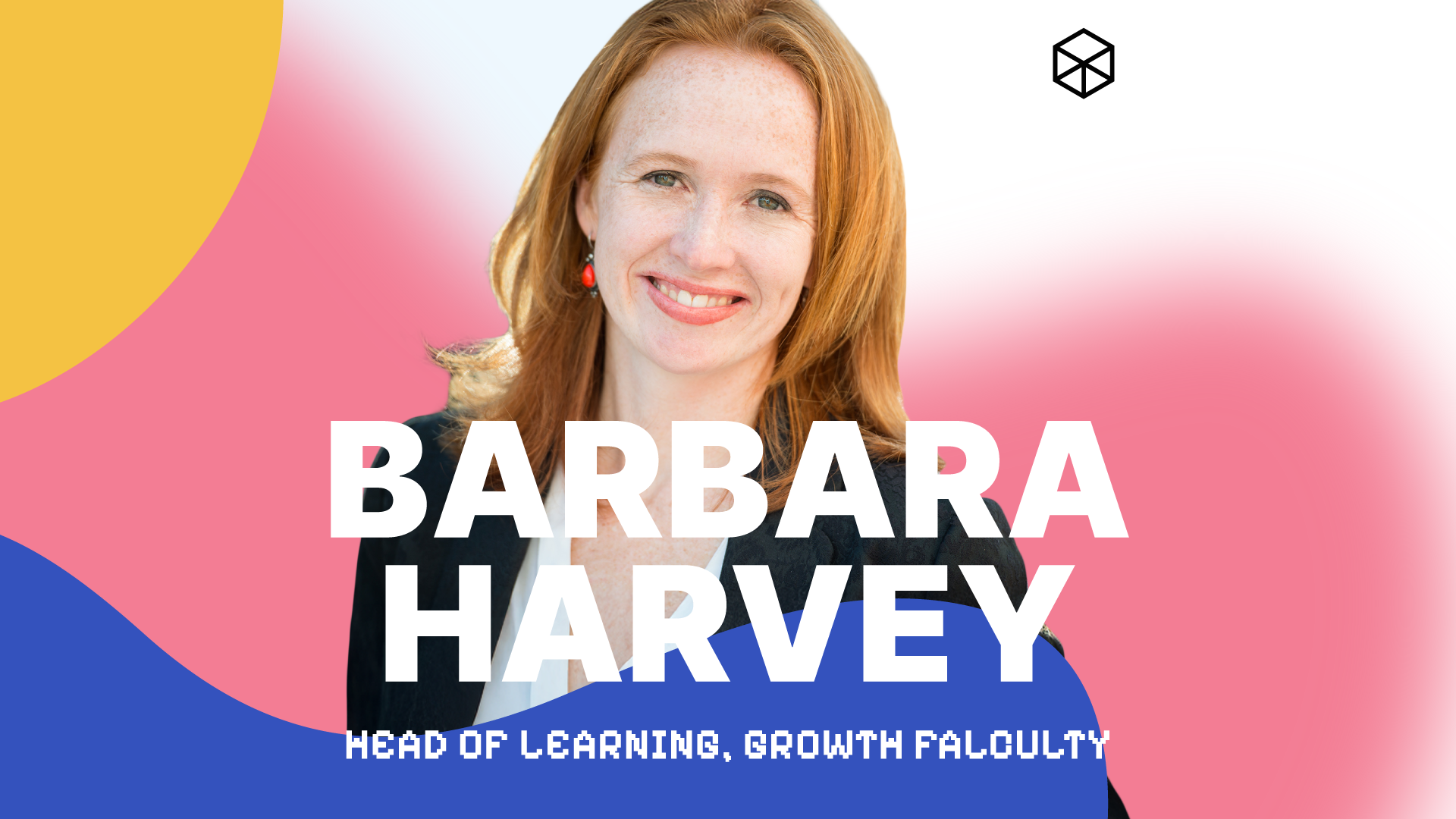
Stop creating "learning landfill" and bring joy back to learning
Guest: Barbara Harvey, Head of Learning @ Growth Faculty
Published: December 5th, 2025
Subscribe: Spotify | Apple Podcasts | YouTube
Episode summary
A high-energy intervention for L&D teams tired of seeing their content pile up unused.
Barbara Harvey is the Head of Learning at Growth Faculty and a leading voice in the evolving world of workplace learning. With over 20 years of experience—beginning her career as a children’s drama teacher—Barbara is deeply passionate about unlocking human potential. She is the author of the Future of Learning industry report and a champion for moving organizations beyond outdated training models toward flexible, socially connected learning cultures that drive real behavioral change.
In this conversation, Barbara combines her research on AI-powered and purpose-led design with practical wisdom. She pulls no punches about why modern "self-directed" learning is failing—describing it as "learning landfill"—and offers a refreshing playbook on how to bring joy back into the process, use AI to deepen (not cheapen) the struggle of learning, and how to "hide the vegetables" to get people engaged.
Key topics
- 🗑️ The "Learning Landfill": Why self-directed learning often piles up unused and why we need a sustainable approach to content.
- 🥦 "Hide the vegetables in the meat": How to make learning joyful and engaging so it doesn't feel like a chore or "school."
- 🎨 Creativity is Research: Debunking the myth of the "magic idea" and why the unsexy work of research is where innovation happens.
- 🤖 AI: Simulation vs. Microwaving: Three transformative use cases for AI (simulation, customization, coaching) and a warning against using AI to make learning too easy.
- 🤔 The Memory Paradox: Why the struggle and discomfort of learning are essential for retention.
Top quotes
“If you wanna do anything different or innovative...and if ChatGPT is just an amalgamation of every idea that’s already existed. The only way to be creative is to take from different places and create something new.”
“We need a more sustainable approach to learning. Sometimes I talk about that self-directed learning... being like learning landfill. It’s just piling, piling up. Great learning, great intentions, but hey, I didn’t use it.”
“You gotta hide the vegetables in the meat... it can’t look like school. It’s gotta be joyful.”
“The easier it is to remember or to learn, the more likely it is you’ll forget... if you don’t have the struggle, if you don’t have the discomfort... you don’t even remember it.”
“The greatest organizations in history... are the ones that learn and grow. When organizations fall apart, it's because they haven't seen the signals coming.”
Resources
- Download the One New Zealand Case Study
- Book a Platform Demo
Full episode
Barbara Harvey: If you want to do anything different or anything innovative or creative, and particularly if Chat GPT is just an amalgamation of every idea that's already existed, then the only way to be creative and innovative is to take from different places and create something new. And so the more exposed you are to different things, different places, different concepts, different industries, the more likely you are to have innovative or contribute to innovative ideas.
Barbara Harvey: Never lose sight of the power and impact of investing and championing learning in your organization. The greatest organizations in history, today, moving forward are the ones that learn and grow. When organizations fall apart is because they haven't seen the signals coming, but if the culture is one of learning and one of openness, I think that is the thing that will set you up in the strongest way for whatever's coming.
Mike Courian: Welcome to Shapeshifters, the podcast on the hunt for passionate individuals who are discovering (and rediscovering) the best ways to transform people, and organisations, for good. I'm your host, Mike Courian. Thanks for being here.
In this episode, I’m speaking with Barbara Harvey. Barbara is the Head of Learning at Growth Faculty and a leading voice in the evolving world of workplace learning. With over 20 years of experience, she is dedicated to figuring out how to unlock human potential.
She’s high energy, creative, and just might be the most enthusiastic learner I’ve had the pleasure of talking to. In this conversation, Barbara brings a refreshing perspective to the challenges of L&D. She pulls back the curtain on why so much modern, self-directed learning is piling up unused—and how we can create a more sustainable approach. You'll hear why she believes we need to "hide the vegetables in the meat,"—making learning engaging so it doesn't feel like a chore. She’ll reveal 3 transformative use cases for AI in learning—not just generating more content. And finally, you'll learn why true creativity isn't magic, but rather the result of diverse inputs, research, and connecting the dots.
Barbara brings an infectious energy to this topic—and has the best analogies. There’s no doubt you will walk away from this convinced that learning is irreplaceable in our organisations, and demands our attention.
Let's jump in.
Mike Courian: Barbara, welcome to the podcast.
Barbara Harvey: Thanks Mike. I'm really happy to be here.
Mike Courian: It's so good to have you. You sent me through a few things as we were talking before this, and probably my favorite was you responding to me, I love personality tests. And everyone else I ask says, no, I'm not into them. Don't box me. And so forgive us as we indulge in this slightly, but I think it'll give us a little picture of who Barbara is. And so, tell me what facet 5 tells you about you.
Barbara Harvey: The reason why I think I love personality tests is I'm a lover of learning and so I have a deep passionate love of learning about yourself. And so the more you learn about yourself, like even BuzzFeed quizzes, like, I'll take anything really if it tells you something else that you can help and grow, then great. You know, you're a cat person or you're a dog person. You know, like it doesn't really matter. Obviously the scientific psychometrics are more valuable, but that's where my love of them comes from and the power that they can have.
Barbara Harvey: with others as well, and even in a team, right? Like if you can understand your team better, because when you know better, you do better, right? And I think when people say, oh, don't put me in a box. Well, that's your choice if you feel like it puts you in a box. Like, right? Like, get out of the box. And I think it's like, use what you need from it. Take what you can learn from it and and and grow and if you don't like it, you don't need to use it, right? No one's forcing you to. Yes. So Facet 5 is based on the big five personality metrics. So the classic ones are introversion, extraversion, whether you get your energy from yourself or from others. The other one's around control. So similar to DISC. And I love it because it is, it's not a you're this or you're that. It's a scale. So you're either if when it comes to, say extroversion, introversion, they call it energy. So there's low energy, high energy. And so it's from one, zero to 10.
Do you wanna guess what my energy level is? From zero to 10?
Mike Courian: Quite high.
Barbara Harvey: Yeah, it's quite high, right? So Facet 5 is a really powerful one and then you can use it with teams as well. It applies across teams and you can use it to kind of understand how you relate to yourself. And then it's also about perception, so how you're being perceived. Really, I haven't changed much since I was a little girl. In kindergarten, I won an award, and the award was enthusiasm for everything. That was at the age of five. And I'm still painfully enthusiastic about everything. And so, I think that's maybe why I like personality tests because even though I grow and I evolve and I change and I mature and keep adding on more models and you know, I learn so much in the work that I do.
You know, I've worked in leadership development for a long, long time. As fundamentally, I'm still the same little kid that I was when I was five, you know, excited about, you know, tying my shoelaces, literally.
Mike Courian: I really resonate with that idea of there feeling like
Mike Courian: strong continuity over many years, and you've come to understand it in such a deeper way, but it still feels like the same thing. I'm curious, I heard you say creative. Does that mean you like contributing ideas? If there's brainstorming happening, that's energizing for you and you enjoy that process?
Barbara Harvey: Yeah, I do. And you know, I've extended my definition of creativity because I'm not an artist in its true sense. I'm not, I did, I was a drama teacher, but I don't physically create anything. But I love being part of a process of creating something new, something innovative. And I love contributing to that. I don't like doing it completely by myself. I need input. And if I am tasked with doing it on my own, you'll find me calling friends, talking to people at the shops. Like I need input to create. But then yeah, that's fundamental to who I am from when I was a kid. And it's funny, I think we spend our lifetime growing up and forgetting who we really are. And you know, there's so many clues in who we were when we were younger that we must tap into. That's when we lose our spark and enjoy sometimes it is actually going back and remembering, what was it? You know, what was it that got you excited as a kid that may have been, you know, you may have lost along the way in pursuing a traditional or just a life.
Mike Courian: Yeah. And then if we think about your role at Growth Faculty at the moment, where do you see these strengths or sometimes I like to call them superpowers? If there's a room full of people coming together, what are the parts of the process that Barbara is unashamedly willing to claim that those are her sweet spots?
Barbara Harvey: So I'm the head of learning at Growth Faculty, and I came from another head of learning that was, my role was really quite structured in terms of, I, you know, I built large programs across Australia, beginning and end. And I was brought on by
Barbara Harvey: I found the courage in BD to say, listen, the organization's shifting, it's changing, it's a live leadership model. So we produce high-end leadership sessions from Patrick Lencioni to Jim Collins. And we're going into organizations where I need to know what's happening with the future of learning. And here we go. And so I had a fairly open canvas in terms of what I had to do. So really I have had to dig into that creativity, but also the collaboration because this is a new space for me. But learning itself is not a program, so it doesn't have to be, you don't just start here and end here. Its people are taking moments. So for me as a learning designer, I'm like, how do we show the application? Like, where is it? So, I had to really think quite, um, abstractly about what learning is, and then what does the application look like in this sense. And so that's been a real creative process. For example, I watched Netflix. I looked at the Doppelganger preferences. They have a whole system of preferences. So, if you open up Netflix sometimes, it'll say 1960s Kung Fu movies. used to just be drama, documentary, and now it's like movies starring females from pull-it surprise winning books, right? So I had to kind of go out and look at different industries, which is a creative process in itself to create analogies from a different place. You know, I looked at you know, all sorts of things to think about, okay, how do we create preferences? And then I came up with an engagement pillar strategy with the team, you know, and that was from meeting with clients, working with everyone, then we came up with this sort of best practice engagement framework. So Growth Faculty, the membership business, is a subscription model. So there's individual subscriptions, and then there's organizations will have
Barbara Harvey: say 100, 200, 300 people engaged. So it's not a one-off. People are going to different sessions. You know, people might go once a quarter, they might go once a month, and everybody's taking something different from it. So if you and your team, for example, came along and you're listening to Jim Collins, what's relevant for you is different. And so it's not a program course where you're all learning the same thing. So it's like, what does that look like in terms of how we enable the learning around it, right? What are the fundamental principles of application of reflection? We had to deconstruct what is learning? What does it look like? What is, what's enough? You know, and we're all, everyone's busy, everyone's busy, no time for learning, which I don't actually subscribe to. I don't agree because brain rot was the word of the year for 2024. Brain rot was the word, which is a, people are wasting their time. So they've got time. They've got time for learning. They're just not prioritizing it.
Mike Courian: Yes.
Barbara Harvey: That's what we had to tackle is most organizations that we speak to, the learning, the content, the quality of the content is not the issue. There's amazing learning out there. You can listen to podcasts, you can watch YouTubes, you can watch TED talks. It's out there. It's great. The issue is the engagement. The issue is people spending time. The issue is people being overwhelmed with all the content. So that's the work. How do you curate? How do you create scaffolding? How do you ensure people are taking the learning and growing and it's not just television. That's the challenge we're trying to tackle.
Mike Courian: Yeah. Oh, that's great. I totally got a picture of it. And you know, you said something like, it's not necessarily the most creative part of the process or something. And what I thought was interesting is thinking about any artists and I've not done art history, so forgive me anyone listening who's just like, you have no idea what you're talking
Mike Courian: about mics. But I imagine a part of the creative process is the research. Before any great work is done, architecturally, painting, sculpture, there's all this research that is really the unsexy, undocumented, it's not really the popularized part of the process.
The outputs really are, and they get all the notoriety, and you miss Da Vinci toiling for a year maybe before something comes out the other side. And so I thought, research. Research, I think, is part of the craft. We don't acknowledge it in the same way societally, but I think it is an exploratory, curious process. I think it's tapping into all these faculties of the capital C creativity.
Barbara Harvey: I think you're spot on with the research being an important part of the creative process and in a way, on this sort of creative quest, it's like the materials that you sculpt with, right? The creativeness is what you do with it. It's like, how do you interpret research into, how do you make meaning from it? You need materials to work with if you're creative, whatever, whatever form you take. And it's so true what you said about being the non-glamorous part. I don't know if you're a fan of Jimmy Carr in the British media. He's one of the most successful standup comics in the world and he's very wealthy. And he said that emerging comedians, see your Netflix show, I'd love to be on Netflix, I'd love to do this, I want that. He says, but what they don't want to do is the 12 hours a day of joke writing that I do every day. They want the lights and the outcome and to be a, have a hit show. But they don't necessarily want the life that goes with it behind the scenes, which is just hard work.
Mike Courian: Yeah.
Barbara Harvey: When you see someone on stage as, you know, a ballerina or whatever, that's, you know, a lifetime of work for that magical moment.
Mike Courian: Yeah.
Barbara Harvey: Yes.
Mike Courian: Yeah.
Barbara Harvey: So then back to the research. First of all, I had a lot of conversations and then I actually went out and surveyed close to 100 learning leaders mainly
Barbara Harvey: in Australia. So people that were either in a learning and development role within an organization, that was one group. And then there was another group that were facilitators, coaches, consultants, learning designers because I wanted to hear directly from those two groups to see what was happening in the industry. That was part of that research. There were nearly 100 people that contributed, there were 40 questions. And then out of that, it's funny, I fed all the data through chat GPT and I let it spit out a report. And I read it and I, it was so, it, it really said nothing. There was nothing really profound about it. And so I sat down and I really honed into what was the data, what were the stories that these people were telling, like what was really happening in the industry and from it I came out with some real key insights. I'll talk you through the insights and then to answer your question about what's working. But there were two insights from the report, and they're not that surprising. The first is that learning is in transition. I've been in workforce learning for 10 years. When I started it, it was all in person, you know, training rooms, catering, workshops all day. And often leadership training was for the elite. It was for either the sort of high potential emerging, you know, there was a select group. So we've seen a real shift from that learning being, you know, you go away to learn, you're in a workshop, it's 9 to 5, tick it off. So what we're seeing is more an agile form of learning. So people are learning bite size, they're doing courses, they're doing a one hour webinar. So that's a big shift. 66% of organizations are now investing more in agile learning and 7% of organizations are saying that traditional learning's not serving them.
Mike Courian: Mmm-hmm.
Barbara Harvey: And I think that's also because of the way we're working, people are working hybrid and the costs of bringing people together. So that's certainly one piece. And then the second insight was that learning is not working. It's broken. Workforce learning is not serving us, partly because we have some issues around measurement.
Barbara Harvey: So, organizations are looking for more evidence that the learning is working. They want to see the return on investment, but the measurement tools we use to measure learning, it doesn't match. Most people still use an engagement, either the engagement scores or just a satisfaction with the learning. But I can't exactly see where the impact is. And I don't think it's problematic for me because learning doesn't necessarily always show up in a linear way, right? But anyway, regardless, it is difficult to show the output of learning at times, particularly soft skills.
Mike Courian: Yes.
Barbara Harvey: And then the third piece is that we have a massive issue with attention control, as we know. This is not just in learning, this is in work, this is with children. Uh, and so people have, people are feeling like they don't have the space and the time to learn. So they're just avoiding it, because there's so much choice. So there's a choice paradox where you can go to this here, there and everywhere. People are booking over their learning, they might have a learning session, but it's like, ah, I've got this meeting instead. You know, it's become an optional thing, like a side dish to your work rather than being integral to your work. So the agile method is great, but then without measurement and then without structure to commit to the learning, we have a problem where now people are disengaging from learning. I think you'll see organizations pulling back funding from learning because they see people are not engaging. If they see there's no outcome, which is, which is a big mistake, but this is the, this is the circumstances of which the industry's in currently.
Mike Courian: It's the negative flywheel of as we deprioritize it, that becomes a self-reinforcing feedback loop that it there's nothing to measure or we're not getting the outcomes and people are not seeing the value and so the whole thing can
Mike Courian: implode. Although that may be a false positive and actually is not an indictment at all on the power and benefit of learning. But if not given the required resource, I can totally see how that happens. I can see your brain thinking right now. What have I sparked in what I said?
Barbara Harvey: Well, I think that I think of learning, investing in your own learning in particular, like your health, right? So the short-term gains are not necessarily there in your week. Yes, okay, go to that meeting or don't listen to that webinar, but the long-term impact and this and this, Andrea Clark who I work with a lot has some stats around this, particularly for women in their 40s. The more they opt out of learning, the bigger the consequences for their career later. It's 10 years down the track, right? So you might not feel it now, but it's like the compounding impact of not, you know, re-skilling, upskilling, staying afloat with your learning. It has an impact later. But if you invest in that growth and that energy in collaboration and connection, that's what's variable, right? That's the real variance. And I think if you do that together, it's time 10. And I feel like if organizations can see the power of like, even the work we do at Growth Faculty, people come together synchronously, having a conversation around the learning. It's Lencioni's work, for example, talking about being a team. That's so you're kind of doubling up, your habit stacking, right? Like you're learning, you're collaborating, you're communicating, you're connecting. Like there's so much power in that.
And the other thing we're seeing more and more is, and we're this massive trend for longevity, right? Like if you listen to any podcast at the moment, longevity's thing is lifelong learning. So now Georgia Tech has just opened a college, a physical bricks and mortar college of lifelong learning from from zero to 100. You can attend the College of Lifelong Learning. I think
Barbara Harvey: What's the name? But you have to understand that you have to fundamentally believe in the power of learning being central to who we are as humans. And that has to come from leadership, right? So the investment has to be believed in more than the outcome productivity metric. For me, they're two kinds of differences, one's training, really, and one's learning. One is upskilling. You have to learn how to build a spreadsheet. like, you can't, if you do your first year of a law degree, you have to learn, you just have to learn it. Like there's no way to magically embed the learning. You have to learn your times tables at some point, right? Like you just have to learn it. So that's training. And we need people trained. We need nurses, we need people. I think often I'm talking more about the self-development side of learning, which is what organizations heavily invest in.
The other thing I think, I love, you know, there's a lot of commencement addresses online at the moment, but, you know, the old classic is Steve Jobs, his commencement speech. And he talked about joining the dots. It's one of my favorite stories of all time about learning in particular. So he went to college and he ended up dropping out of college, but while he was at college, he took a calligraphy course, and he used to just go to classes. And it was only years later when he was working on the first Apple Mac, and he looked into the fonts and the typography, and the Mac at the time was just revolutionary in having font options. And he didn't know at the time when he took the calligraphy course how significant it was. And I think you don't know what you need right now, right? Like you don't know if you need the calligraphy class. So if we're only learning what we need, if we're only YouTube searching, okay, I need to get better at this. I need to get better at that. That's, that's very limiting for our long-term career and learning because I did a course many years ago,
Barbara Harvey: on format production of TV formats at the Australian Film School afters, years and years ago I did because I was working in film production. Many years later, I used that format design in my learning design. So the Bachelor, all those shows are formatted franchise TV shows. So I studied that. And so when I design courses, I think about the format and the visuals from that film course, right? But I didn't know that. I didn't know I'd end up learning design, right? So I think that's another challenge in learning is people, you know, having to be so relevant, mapping to capability. I mean, we do need that, but that's one of the, that's one of the conundrums. How do you know what you don't know? How do you know what you don't need yet, right?
Mike Courian: So are you saying that that curiosity is going to be the antidote to the future of work? Because we don't need to know what the future of work looks like. We just need to keep this curiosity alive in ourselves because we might be off on this tangent of learning about the format of these reality TV shows and yet it is the unlock for us in six months, 12 months time when we're on a project. And so, how does a senior exec trust the process that much? How do you keep it feeling like an investment that you can justify to the board?
Barbara Harvey: I'm just thinking about this for the first time. Like, so some, in some organizations, learning and development feels a function of building capability that requires being built, right? So if you're having to digitally upskill people or, you know, it might be in construction and so forth. So that's so leaving that aside, if we agree here that having curiosity, being open-minded, if you want to do anything different or anything innovative or creative, and particularly if Chat GBT is just an
Barbara Harvey: amalgamation of every idea that's already existed, then the only way to be creative and innovative is to take from different places and create something new. And so the more exposed you are, that's why I love whenever I hear someone with an accent, I go, oh, you've got two perspectives. You've lived in two countries, right? So if you, the more exposed you are to different things, different places, different concepts, different industries, the more likely you are to have innovative or contribute to innovative ideas if you're in a team.
So I think in this case, for example, if you were an exec and you wanted to foster, you know, high levels of creativity, and people do this, you might give people $500 to a $1,000 creative learning budget. And they can go and learn, they can learn to loom or they can go cooking or they go, the problem is will they actually go and show up? I think that's another issue, but, but that's one way you could do it. And it doesn't have to be a lot of money, but you're sending a signal and a message that creativity and curiosity is important to us.
Mike Courian: The Shapeshifters podcast is brought to you by Makeshapes. Group learning delivery for the modern workplace. Makeshapes is a digital platform designed specifically to help large and complex organizations deliver critical talent and transformation initiatives at scale. Makeshapes enables delivery of meaningful group learning experiences that are not reliant on an army of facilitators, so you can reach everyone quickly and consistently.
Ready to transform learning and development delivery? Visit makeshapes.com and book in a demo. And if you mention that you heard about Makeshapes on the Shapeshifters podcast, you can get 20% off your first year.
And how do we unlock your whole person is another thought that kind of connects with this. It's fascinating to me because the metaphor that I was having in my mind before of the artists doing their research is,
Mike Courian: We're coming back to that again. How do you send people off to do these explorations? You wrote to me that an area you're exploring is the power of curiosity and joy of learning. What do you say to people? I think some people don't enjoy the learning process. Where do they start on this journey?
Barbara Harvey: So I think, so two things. I think that's something's happened, right? That I think that we're all born, we are born to learn. You look at us, I'm in Australia right now, and we have the oldest living culture in the world, and the reason why it is, is because of the power of storytelling, the power of learning, and learning through story, learning through growth, learning through mentoring and peers. And it is beautiful, right? And I think what's happened often is, you know, the late Sir Ken Robinson said that he'd often go to parties and people would get him up against the wall and tell him just these horrendous stories of their schooling. They've had a bad experience at school.
So when I meet people that usually don't like learning, something's happened. They've hated school, they've hated being in the classroom, they didn't want to learn. But everyone's got the power. Everyone's got some, something they're excited about in learning. I've never met anyone that doesn't want to learn something. Maybe they hate, they don't like formal learning, maybe they don't like being at school, but then they love, you know, they're into, you know, bush walking or whatever it is. Everyone has something they're interested in and they usually like learning about that.
And so the question I ask people, and you know I have teenagers and other people that want to, oh, what am I going to do with my life? There's just one question. What do you get excited about? What is the thing that you enjoy doing? And then how do you like learning about that? And that tells you a lot about the kind of learner you are. Some people want to just be in a room and chat. You know, and that they like that. Some people like to go off and investigate. So I kind of challenge usually when people say they don't like learning, they don't like
Barbara Harvey: format that the learning's coming to them is usually the case.
Mike Courian: Because coming back to the insights, traditional methods aren't working or people are preferring agile learning methods. Measurement is hard and so there becomes all sorts of problems that spin off of that, and the problem of attention at the moment. And then you described attention also as it's hard to engage people. And so it's interesting thinking about everybody's got their thing. And so I wonder if we come back now towards the future of learning industry reports, how do we help engage people? How do we get their buy in?
Barbara Harvey: You got to hide the vegetables in the meat. I think that is the point, right? So it can't look like school. Right? You got to hide it. You got to hide the learning. So, and what I mean by that is like, is it going to be joyful? Is it, so their experience of school? If that's the case, is, oh, learning's a chore, I had to sit still, I had to listen to the teacher, my input wasn't, I always had to have the answers. If I got the answers wrong, I felt bad. So a joyful learning spirit, it doesn't really matter whether you get something right or wrong, right, as an adult in learning, it's a safe space usually, it's supposed to be, and it's about testing how you think and feel. So you've got to create, first of all, the learning experience, if it's a learning experience it has to be creative, interesting, engaging.
But I think really, it needs to be a peer and a social learning experience. That's not everybody wants to learn together, but that is a way in a working environment for that learning to feel less like school. If they're learning from each other, with each other, if it's relevant, you know, if it's timely, all those sorts of things kind of counter what school looked like. But interestingly enough with school, if you were homeschooling children during COVID, what everyone noticed was that the learning actually took place over a few hours and school was done.
Barbara Harvey: Right? And it was like, oh, okay, well, what are they doing all day? Like, how is it turning six hours? And the kids themselves at first were enjoying home learning, they enjoyed being at home. But pretty much not too long into it, there was some longing to be back at school because what they longed for was assembly, recess, lunch, library, the rituals, the social, the connection, the excursions, the swimming carnivals, the running carnivals. And that's actually probably 50% of learning is those experiences. So, I think that often that negative association with learning is that it wasn't enjoyable. And so my argument is that learning should be joyful. And even you've got to enjoy the struggle of it, which, you know, you mentioned as well, is that and being okay that it can be a discomfort leads to, you know, growth and development. So, I think a lot of people don't understand, they're not aware enough of how much growth you receive from learning and how it is really a superpower for your life and career. And so it's like, oh, I'll just put it to the side, you know?
Mike Courian: Yeah. And so I kind of want to give you more space to tell me more of what you've learned through the Future of Learning industry report. I believe I've identified where we're at now. Can you tell me more about the new models that are emerging and how we're compensating for the current state?
Barbara Harvey: So there were three big trends that came through, but I think overall, what I saw was and I've I've talked about this before is that we need a more sustainable approach to learning. So sometimes I talk about that self-directed learning, that kind of glut of learning being like the learning landfall. It's just we're just piling up learning.
Mike Courian: And we're never gonna deal with that landfill. It just keeps piling up.
Barbara Harvey: It just keeps getting up. I don't know if you saw that poster of Shein with the clothes coming out. Yeah, so it's just pile, piling, piling up. Great learning, great intentions, but hey,
Barbara Harvey: and now it's moved to the garage, and then it's out on the street for the clear up, right? And so my overall impression from the report is that we've got to think sustainably about learning. So there is mapping that needs to be done. For example, if the organization chooses to put some money into curiosity learning, that's, that's intentional, right? That's not free for all, that's intentional. We need to look at repurposing the learning, coming back to it, revisiting it, and then integrating, you know, so we need to have a more holistic approach. And sometimes L&D functions say, oh, I want to treat people like adults. They're, they're grown-ups. We don't want to baby them, we don't want to do that. I'm like, well, you know what happens when you leave people to go to the gym? Like, most adults don't go, right? Like, we're adults, but we're also distracted and we have all these lives. So you do need scaffolding, you need cadence, you need structure, you need timing, you need a schedule. And you need to put that foundational work in and then let people choose.
Mike Courian: because you start looking at areas that have all of a sudden expanded rapidly and I think about when CrossFit started and there's these crews and people are the sense of accountability and and togetherness and we're we're just primed this way and you've been saying this throughout but it's just sort of hitting me fresh how much we are primed to be together.
Barbara Harvey: We don't like to let other people down, but we're happy to let ourselves down. If I've got to go for a walk every day, but, you know, gosh, I got to meet my friends. She got up at 6:00 a.m. I can't let her down. But I'm happy to just not go for myself, right? Find another reason to keep hitting the snooze button. So I think the accountability around holding each other to account is really important. I think that's really, that's a big one.
The other thing that came out of it was peer learning, so the power of peer learning, coaching and mentoring. When I joined the industry, coaching was for the execs. There was executive coaching. Now coaching as a concept gets integrated into most learning programs. So that was a big shift. And that, I think, speaks to the
Barbara Harvey: people want to learn as well. Mentoring is not about telling people what to think and do. It's about people coming to their own choices, getting people to the choice where they have no choice. And they've got to make those decisions. And so that's a whole mindset shift. And the third one is the power of AI. 50% of people were excited about the power of AI in learning. So we're definitely seeing a shift in the industry itself, in the way people are learning, and how people are thinking about, you know, growth and big things.
Mike Courian: People are excited about AI, but how are we going to use AI for learning? How are you starting to get signals on how to use it well and how to use it poorly?
Barbara Harvey: I did a bit of research and I went and I looked up some of the great learning programs that have won awards this year, in 2025. For me there were three categories. So the first was using AI in simulation. Organizations are using it to create an experience where people role play, for example. And I looked at Sydney Trains, dealing with an issue of aggressive and disgruntled members of the public with staff.
The staff were being tasked with how to de-escalate situations and communication. So even things like people would drop their AirPods in on tracks and the train's about to come. And everyday people go, I've got to jump down and get my AirPods. And the train staff are like, no, you're not doing that. And of course, they've got to then watch their AirPods getting run over. So they're in these high stakes communication environments. And so they developed this tool with AI where the staff get to communicate with four avatars and they were all sort of different scenarios. You know, it changes according to what you say. And the avatars have been fed these long back stories. If they said something to this one particular guy, he just lost his job. So if they'd said something that was anything to do with money, like you're going to get a fine for smoking on the, you know? So, their job was to de-escalate.
Barbara Harvey: So what a great use of AI, you know? And they and they could practice and then they didn't just do it in the one-off, they had to then do it in a facilitated environment. So there's AI for simulation, which I think's incredible. The second one is the customization, the preference, the algorithms around learning. So we see that in LMSs. We're using it at the Growth Faculty too. It's interesting because my, one of my mentors, Anthony Morris, he's like, well, we've got all this personalization and customization, but are we just actually learning more and more on our own and we're just getting more, you know, back to the point about, are we just learning what we want to learn and we're not learning what we need to learn? So, but anyway,
The reality is we're getting more technology and making learning cleaner and so forth.
And then the third piece of which I'm following and most interested in at the moment is around using AI as a coach and mentor. So, where you've seen the likes of Sal Khan from the Khan Academy, when ChatGPT initially was brought out, you know, schools were very against it, and were seen as cheating. And then he's now working with the Khan Academy, they've got a Socratic tutoring approach, it's called Khanmigo. And so the Khanmigo will say, let's do it together. What do you think about this? Doot, doot, doot, doot, doot. So it's more of an exchange.
And I think that's really interesting. And we're doing this at the Growth Faculty too. We're doing AI mentors. So we're working where our thought leaders are inputting all, you know, their work, and then you can have a conversation with the tutor. Where I am more worried about AI in learning is the issue of, I call it microwaving the learning or microwaving instruction is just going and then it's done because we know that that doesn't work. I know even as an instructional designer, I can easily go, create a session that's...
Barbara Harvey: minutes on the future of learning, create an outline, but at what cost? A, I'm losing my skill. B, it's not original thinking, and C, you know, yeah, it's quite dangerous. We have to be a little bit careful. So there's a learning scientist for Barbara Oakley, and she talks about the memory paradox. Basically, the easier it is to remember or to learn, the more likely it is you'll forget.
Mike Courian: Yes.
Barbara Harvey: If you don't have the struggle, if you don't have the discomfort, if you haven't gone through the process of joining all those dots, doing all that research and coming to those, if you just go sh, through the data in, then you don't even remember it. You can't even talk about it, you know, down the line. So we have to be careful about shortcutting the learning and not kind of missing the step, the struggle and the discomfort to get to the insight.
Mike Courian: I can't help but think how much more this raises the stakes for learning design and learning teams. This is not the time where it's easier to do their job. This is actually the time where it might be harder.
Barbara Harvey: Yeah.
Mike Courian: Because they're really stretched to create these rich learning experiences that are, like you said earlier, full of joy and are genuinely invitational. And it is hiding the vegetables. But when I first heard that, I was like, I don't like that. That's like a bait and switch. But what I actually think you were really saying was people will happily eat vegetables as part of a beautiful meal. But they won't if it's, if you're just hiding it in something that's average to begin with. And so I think there's something really interesting there.
Barbara Harvey: The great learners and the great leaders have an active practice of learning. So they do that. They actually reflect as they go. And they're not hard on themselves about it. They just go, okay, that didn't go. Like, I'll finish today and I'll reflect, okay. And I'm not going, oh, I should have said that. I'm going, okay, well, that went well. I might do that next. So, in a way, if you had AI to
Barbara Harvey: prompt you to reflect on the go. I think that would be a really powerful and useful application. often IT teams are the greatest learners because their approach is learning, right? Like they're testing the software, they're trying to make it break, you know, so yeah, they're often and got the right mindset.
Mike Courian: On a high level, it's a really interesting thing for how does an organization prepare well for this unknown future, allowing more cross pollination across your best thinkers across the organization. And and like we said, in that meaning making research phase of a project, inviting a wide variety of of views to see things that some people might not be seeing, that are opportunities for a particular project in a particular part of the business, so that it can feed into this larger vision of flexing into this unknown future. Barbara, if you were to get up on your soap box and you had one thing you could say to learning execs, senior leaders, what is it you'd love to help them see that you can see that they might not have seen yet?
Barbara Harvey: I think it's to never lose sight of the power and impact of investing and championing learning in your organization. Like the greatest organizations in history, today, moving forward are the ones that learn and grow. And often what we see when organizations fall apart, they don't make, you know, make it to the next phase is because they've had blinkered vision, you know, they haven't seen the signals coming, they haven't been open, they might have had a toxic culture. And I know this sounds really idealistic, but if the culture is one of learning and one of openness and open communication, I think that is the thing that will set you up for the most success and being the most future ready, really. It's like we've said, we just don't know what the future's going to look like. So if your people are curious and if they're open, and they're willing to have critical feedback from each
Barbara Harvey: That's a, that's a learning mindset too, then that's going to position you in the strongest way for whatever's coming. Right, whatever's coming our way.
Mike Courian: Do you have any Barbara secrets to the good life? Just like little things that you do regularly that keep you sane or you think really make a difference?
Barbara Harvey: My goodness. What a question. It's not Barbara's secret. It's my mom, Angela Willis . She's 81. And it's so simple. There are two things and I live by it. And it is day by day, one day at a time, one foot in front of the other.
And that's it. I just wake up, day by day.
Mike Courian: It's the 20-mile march.
Barbara Harvey: It's the 20-mile march. And you do click away, click away, click away. Yeah, that's about it.
In terms of my own thing, I don't know. I think I don't know if I have any secrets. I think I use everyone else's. I'm a great plagiarizer of advice. I'm a great curator of
Mike Courian: But I like the fact that you have a mother that you quoted as a guiding light, I thought you were a lucky kid to have that.
Barbara Harvey: She's a massive influence. She's a school teacher, right? Like I grew up with a school teacher as a mum. So, I think it's really basic, but I think especially as you get older, life kicks you at times, it's great at times, you know, in your early 20s, everything's great. But as you get older, you've got kids and work and careers. I just think it's the consistency of turning up, doing the work, enjoying the work, doesn't always feel great, you know? Where's the joy? Where's the learning? To keep going. And I think that's why I love learning because no matter what happens, even if something really difficult happens to you, if you're able to find the learning in it and grow from it, then really you can deal with anything that comes your way and ultimately you'll be better for it. It might not feel like it at the time. So I think if you can always look for the learning, you'll make it. You'll be all right.
Mike Courian: Well, Barbara, it has been an absolute pleasure.
Mike Courian: You are joy in yourself, and I know you're invoking all this joy and learning. So, thank you, thank you for your time. Thank you for your wisdom.
Barbara Harvey: Thank you, Mike, and I've learned a lot too. So, it's been a real pleasure and I had a great day.
Mike Courian: And that wraps up this episode of Shapeshifters. Thanks so much for being with us.
We really want this to become a two-way conversation, so we would love for you to send in any questions or comments that this episode has prompted. You can do that by emailing shapeshifters@makeshapes.com, or if you're listening on Spotify, you can drop it into the comment section. We'll be incorporating these questions and comments into future episodes.
Remember, if you want to stay up to date with the podcast, go to the Shapeshifters website, link in the description, and sign up to our community.
I'm grateful for all of you. This is a real joy for me to get to do this. So, thank you for your support.
Until next time, I'm Mike Courian, and this is Shapeshifters.
About Shapeshifters
Shapeshifters is the podcast exploring how innovative L&D leaders are breaking traditional trade-offs to deliver transformative learning at scale. Hosted by the Makeshapes team, each episode features candid conversations with pioneers who are reshaping how organizations learn, grow, and thrive.
Subscribe: Spotify | Apple Podcasts | YouTube

challenge

solution
Stop creating "learning landfill" and bring joy back to learning
Guest: Barbara Harvey, Head of Learning @ Growth Faculty
Published: December 5th, 2025
Subscribe: Spotify | Apple Podcasts | YouTube
Episode summary
A high-energy intervention for L&D teams tired of seeing their content pile up unused.
Barbara Harvey is the Head of Learning at Growth Faculty and a leading voice in the evolving world of workplace learning. With over 20 years of experience—beginning her career as a children’s drama teacher—Barbara is deeply passionate about unlocking human potential. She is the author of the Future of Learning industry report and a champion for moving organizations beyond outdated training models toward flexible, socially connected learning cultures that drive real behavioral change.
In this conversation, Barbara combines her research on AI-powered and purpose-led design with practical wisdom. She pulls no punches about why modern "self-directed" learning is failing—describing it as "learning landfill"—and offers a refreshing playbook on how to bring joy back into the process, use AI to deepen (not cheapen) the struggle of learning, and how to "hide the vegetables" to get people engaged.
Key topics
- 🗑️ The "Learning Landfill": Why self-directed learning often piles up unused and why we need a sustainable approach to content.
- 🥦 "Hide the vegetables in the meat": How to make learning joyful and engaging so it doesn't feel like a chore or "school."
- 🎨 Creativity is Research: Debunking the myth of the "magic idea" and why the unsexy work of research is where innovation happens.
- 🤖 AI: Simulation vs. Microwaving: Three transformative use cases for AI (simulation, customization, coaching) and a warning against using AI to make learning too easy.
- 🤔 The Memory Paradox: Why the struggle and discomfort of learning are essential for retention.
Top quotes
“If you wanna do anything different or innovative...and if ChatGPT is just an amalgamation of every idea that’s already existed. The only way to be creative is to take from different places and create something new.”
“We need a more sustainable approach to learning. Sometimes I talk about that self-directed learning... being like learning landfill. It’s just piling, piling up. Great learning, great intentions, but hey, I didn’t use it.”
“You gotta hide the vegetables in the meat... it can’t look like school. It’s gotta be joyful.”
“The easier it is to remember or to learn, the more likely it is you’ll forget... if you don’t have the struggle, if you don’t have the discomfort... you don’t even remember it.”
“The greatest organizations in history... are the ones that learn and grow. When organizations fall apart, it's because they haven't seen the signals coming.”
Resources
- Download the One New Zealand Case Study
- Book a Platform Demo
Full episode
Barbara Harvey: If you want to do anything different or anything innovative or creative, and particularly if Chat GPT is just an amalgamation of every idea that's already existed, then the only way to be creative and innovative is to take from different places and create something new. And so the more exposed you are to different things, different places, different concepts, different industries, the more likely you are to have innovative or contribute to innovative ideas.
Barbara Harvey: Never lose sight of the power and impact of investing and championing learning in your organization. The greatest organizations in history, today, moving forward are the ones that learn and grow. When organizations fall apart is because they haven't seen the signals coming, but if the culture is one of learning and one of openness, I think that is the thing that will set you up in the strongest way for whatever's coming.
Mike Courian: Welcome to Shapeshifters, the podcast on the hunt for passionate individuals who are discovering (and rediscovering) the best ways to transform people, and organisations, for good. I'm your host, Mike Courian. Thanks for being here.
In this episode, I’m speaking with Barbara Harvey. Barbara is the Head of Learning at Growth Faculty and a leading voice in the evolving world of workplace learning. With over 20 years of experience, she is dedicated to figuring out how to unlock human potential.
She’s high energy, creative, and just might be the most enthusiastic learner I’ve had the pleasure of talking to. In this conversation, Barbara brings a refreshing perspective to the challenges of L&D. She pulls back the curtain on why so much modern, self-directed learning is piling up unused—and how we can create a more sustainable approach. You'll hear why she believes we need to "hide the vegetables in the meat,"—making learning engaging so it doesn't feel like a chore. She’ll reveal 3 transformative use cases for AI in learning—not just generating more content. And finally, you'll learn why true creativity isn't magic, but rather the result of diverse inputs, research, and connecting the dots.
Barbara brings an infectious energy to this topic—and has the best analogies. There’s no doubt you will walk away from this convinced that learning is irreplaceable in our organisations, and demands our attention.
Let's jump in.
Mike Courian: Barbara, welcome to the podcast.
Barbara Harvey: Thanks Mike. I'm really happy to be here.
Mike Courian: It's so good to have you. You sent me through a few things as we were talking before this, and probably my favorite was you responding to me, I love personality tests. And everyone else I ask says, no, I'm not into them. Don't box me. And so forgive us as we indulge in this slightly, but I think it'll give us a little picture of who Barbara is. And so, tell me what facet 5 tells you about you.
Barbara Harvey: The reason why I think I love personality tests is I'm a lover of learning and so I have a deep passionate love of learning about yourself. And so the more you learn about yourself, like even BuzzFeed quizzes, like, I'll take anything really if it tells you something else that you can help and grow, then great. You know, you're a cat person or you're a dog person. You know, like it doesn't really matter. Obviously the scientific psychometrics are more valuable, but that's where my love of them comes from and the power that they can have.
Barbara Harvey: with others as well, and even in a team, right? Like if you can understand your team better, because when you know better, you do better, right? And I think when people say, oh, don't put me in a box. Well, that's your choice if you feel like it puts you in a box. Like, right? Like, get out of the box. And I think it's like, use what you need from it. Take what you can learn from it and and and grow and if you don't like it, you don't need to use it, right? No one's forcing you to. Yes. So Facet 5 is based on the big five personality metrics. So the classic ones are introversion, extraversion, whether you get your energy from yourself or from others. The other one's around control. So similar to DISC. And I love it because it is, it's not a you're this or you're that. It's a scale. So you're either if when it comes to, say extroversion, introversion, they call it energy. So there's low energy, high energy. And so it's from one, zero to 10.
Do you wanna guess what my energy level is? From zero to 10?
Mike Courian: Quite high.
Barbara Harvey: Yeah, it's quite high, right? So Facet 5 is a really powerful one and then you can use it with teams as well. It applies across teams and you can use it to kind of understand how you relate to yourself. And then it's also about perception, so how you're being perceived. Really, I haven't changed much since I was a little girl. In kindergarten, I won an award, and the award was enthusiasm for everything. That was at the age of five. And I'm still painfully enthusiastic about everything. And so, I think that's maybe why I like personality tests because even though I grow and I evolve and I change and I mature and keep adding on more models and you know, I learn so much in the work that I do.
You know, I've worked in leadership development for a long, long time. As fundamentally, I'm still the same little kid that I was when I was five, you know, excited about, you know, tying my shoelaces, literally.
Mike Courian: I really resonate with that idea of there feeling like
Mike Courian: strong continuity over many years, and you've come to understand it in such a deeper way, but it still feels like the same thing. I'm curious, I heard you say creative. Does that mean you like contributing ideas? If there's brainstorming happening, that's energizing for you and you enjoy that process?
Barbara Harvey: Yeah, I do. And you know, I've extended my definition of creativity because I'm not an artist in its true sense. I'm not, I did, I was a drama teacher, but I don't physically create anything. But I love being part of a process of creating something new, something innovative. And I love contributing to that. I don't like doing it completely by myself. I need input. And if I am tasked with doing it on my own, you'll find me calling friends, talking to people at the shops. Like I need input to create. But then yeah, that's fundamental to who I am from when I was a kid. And it's funny, I think we spend our lifetime growing up and forgetting who we really are. And you know, there's so many clues in who we were when we were younger that we must tap into. That's when we lose our spark and enjoy sometimes it is actually going back and remembering, what was it? You know, what was it that got you excited as a kid that may have been, you know, you may have lost along the way in pursuing a traditional or just a life.
Mike Courian: Yeah. And then if we think about your role at Growth Faculty at the moment, where do you see these strengths or sometimes I like to call them superpowers? If there's a room full of people coming together, what are the parts of the process that Barbara is unashamedly willing to claim that those are her sweet spots?
Barbara Harvey: So I'm the head of learning at Growth Faculty, and I came from another head of learning that was, my role was really quite structured in terms of, I, you know, I built large programs across Australia, beginning and end. And I was brought on by
Barbara Harvey: I found the courage in BD to say, listen, the organization's shifting, it's changing, it's a live leadership model. So we produce high-end leadership sessions from Patrick Lencioni to Jim Collins. And we're going into organizations where I need to know what's happening with the future of learning. And here we go. And so I had a fairly open canvas in terms of what I had to do. So really I have had to dig into that creativity, but also the collaboration because this is a new space for me. But learning itself is not a program, so it doesn't have to be, you don't just start here and end here. Its people are taking moments. So for me as a learning designer, I'm like, how do we show the application? Like, where is it? So, I had to really think quite, um, abstractly about what learning is, and then what does the application look like in this sense. And so that's been a real creative process. For example, I watched Netflix. I looked at the Doppelganger preferences. They have a whole system of preferences. So, if you open up Netflix sometimes, it'll say 1960s Kung Fu movies. used to just be drama, documentary, and now it's like movies starring females from pull-it surprise winning books, right? So I had to kind of go out and look at different industries, which is a creative process in itself to create analogies from a different place. You know, I looked at you know, all sorts of things to think about, okay, how do we create preferences? And then I came up with an engagement pillar strategy with the team, you know, and that was from meeting with clients, working with everyone, then we came up with this sort of best practice engagement framework. So Growth Faculty, the membership business, is a subscription model. So there's individual subscriptions, and then there's organizations will have
Barbara Harvey: say 100, 200, 300 people engaged. So it's not a one-off. People are going to different sessions. You know, people might go once a quarter, they might go once a month, and everybody's taking something different from it. So if you and your team, for example, came along and you're listening to Jim Collins, what's relevant for you is different. And so it's not a program course where you're all learning the same thing. So it's like, what does that look like in terms of how we enable the learning around it, right? What are the fundamental principles of application of reflection? We had to deconstruct what is learning? What does it look like? What is, what's enough? You know, and we're all, everyone's busy, everyone's busy, no time for learning, which I don't actually subscribe to. I don't agree because brain rot was the word of the year for 2024. Brain rot was the word, which is a, people are wasting their time. So they've got time. They've got time for learning. They're just not prioritizing it.
Mike Courian: Yes.
Barbara Harvey: That's what we had to tackle is most organizations that we speak to, the learning, the content, the quality of the content is not the issue. There's amazing learning out there. You can listen to podcasts, you can watch YouTubes, you can watch TED talks. It's out there. It's great. The issue is the engagement. The issue is people spending time. The issue is people being overwhelmed with all the content. So that's the work. How do you curate? How do you create scaffolding? How do you ensure people are taking the learning and growing and it's not just television. That's the challenge we're trying to tackle.
Mike Courian: Yeah. Oh, that's great. I totally got a picture of it. And you know, you said something like, it's not necessarily the most creative part of the process or something. And what I thought was interesting is thinking about any artists and I've not done art history, so forgive me anyone listening who's just like, you have no idea what you're talking
Mike Courian: about mics. But I imagine a part of the creative process is the research. Before any great work is done, architecturally, painting, sculpture, there's all this research that is really the unsexy, undocumented, it's not really the popularized part of the process.
The outputs really are, and they get all the notoriety, and you miss Da Vinci toiling for a year maybe before something comes out the other side. And so I thought, research. Research, I think, is part of the craft. We don't acknowledge it in the same way societally, but I think it is an exploratory, curious process. I think it's tapping into all these faculties of the capital C creativity.
Barbara Harvey: I think you're spot on with the research being an important part of the creative process and in a way, on this sort of creative quest, it's like the materials that you sculpt with, right? The creativeness is what you do with it. It's like, how do you interpret research into, how do you make meaning from it? You need materials to work with if you're creative, whatever, whatever form you take. And it's so true what you said about being the non-glamorous part. I don't know if you're a fan of Jimmy Carr in the British media. He's one of the most successful standup comics in the world and he's very wealthy. And he said that emerging comedians, see your Netflix show, I'd love to be on Netflix, I'd love to do this, I want that. He says, but what they don't want to do is the 12 hours a day of joke writing that I do every day. They want the lights and the outcome and to be a, have a hit show. But they don't necessarily want the life that goes with it behind the scenes, which is just hard work.
Mike Courian: Yeah.
Barbara Harvey: When you see someone on stage as, you know, a ballerina or whatever, that's, you know, a lifetime of work for that magical moment.
Mike Courian: Yeah.
Barbara Harvey: Yes.
Mike Courian: Yeah.
Barbara Harvey: So then back to the research. First of all, I had a lot of conversations and then I actually went out and surveyed close to 100 learning leaders mainly
Barbara Harvey: in Australia. So people that were either in a learning and development role within an organization, that was one group. And then there was another group that were facilitators, coaches, consultants, learning designers because I wanted to hear directly from those two groups to see what was happening in the industry. That was part of that research. There were nearly 100 people that contributed, there were 40 questions. And then out of that, it's funny, I fed all the data through chat GPT and I let it spit out a report. And I read it and I, it was so, it, it really said nothing. There was nothing really profound about it. And so I sat down and I really honed into what was the data, what were the stories that these people were telling, like what was really happening in the industry and from it I came out with some real key insights. I'll talk you through the insights and then to answer your question about what's working. But there were two insights from the report, and they're not that surprising. The first is that learning is in transition. I've been in workforce learning for 10 years. When I started it, it was all in person, you know, training rooms, catering, workshops all day. And often leadership training was for the elite. It was for either the sort of high potential emerging, you know, there was a select group. So we've seen a real shift from that learning being, you know, you go away to learn, you're in a workshop, it's 9 to 5, tick it off. So what we're seeing is more an agile form of learning. So people are learning bite size, they're doing courses, they're doing a one hour webinar. So that's a big shift. 66% of organizations are now investing more in agile learning and 7% of organizations are saying that traditional learning's not serving them.
Mike Courian: Mmm-hmm.
Barbara Harvey: And I think that's also because of the way we're working, people are working hybrid and the costs of bringing people together. So that's certainly one piece. And then the second insight was that learning is not working. It's broken. Workforce learning is not serving us, partly because we have some issues around measurement.
Barbara Harvey: So, organizations are looking for more evidence that the learning is working. They want to see the return on investment, but the measurement tools we use to measure learning, it doesn't match. Most people still use an engagement, either the engagement scores or just a satisfaction with the learning. But I can't exactly see where the impact is. And I don't think it's problematic for me because learning doesn't necessarily always show up in a linear way, right? But anyway, regardless, it is difficult to show the output of learning at times, particularly soft skills.
Mike Courian: Yes.
Barbara Harvey: And then the third piece is that we have a massive issue with attention control, as we know. This is not just in learning, this is in work, this is with children. Uh, and so people have, people are feeling like they don't have the space and the time to learn. So they're just avoiding it, because there's so much choice. So there's a choice paradox where you can go to this here, there and everywhere. People are booking over their learning, they might have a learning session, but it's like, ah, I've got this meeting instead. You know, it's become an optional thing, like a side dish to your work rather than being integral to your work. So the agile method is great, but then without measurement and then without structure to commit to the learning, we have a problem where now people are disengaging from learning. I think you'll see organizations pulling back funding from learning because they see people are not engaging. If they see there's no outcome, which is, which is a big mistake, but this is the, this is the circumstances of which the industry's in currently.
Mike Courian: It's the negative flywheel of as we deprioritize it, that becomes a self-reinforcing feedback loop that it there's nothing to measure or we're not getting the outcomes and people are not seeing the value and so the whole thing can
Mike Courian: implode. Although that may be a false positive and actually is not an indictment at all on the power and benefit of learning. But if not given the required resource, I can totally see how that happens. I can see your brain thinking right now. What have I sparked in what I said?
Barbara Harvey: Well, I think that I think of learning, investing in your own learning in particular, like your health, right? So the short-term gains are not necessarily there in your week. Yes, okay, go to that meeting or don't listen to that webinar, but the long-term impact and this and this, Andrea Clark who I work with a lot has some stats around this, particularly for women in their 40s. The more they opt out of learning, the bigger the consequences for their career later. It's 10 years down the track, right? So you might not feel it now, but it's like the compounding impact of not, you know, re-skilling, upskilling, staying afloat with your learning. It has an impact later. But if you invest in that growth and that energy in collaboration and connection, that's what's variable, right? That's the real variance. And I think if you do that together, it's time 10. And I feel like if organizations can see the power of like, even the work we do at Growth Faculty, people come together synchronously, having a conversation around the learning. It's Lencioni's work, for example, talking about being a team. That's so you're kind of doubling up, your habit stacking, right? Like you're learning, you're collaborating, you're communicating, you're connecting. Like there's so much power in that.
And the other thing we're seeing more and more is, and we're this massive trend for longevity, right? Like if you listen to any podcast at the moment, longevity's thing is lifelong learning. So now Georgia Tech has just opened a college, a physical bricks and mortar college of lifelong learning from from zero to 100. You can attend the College of Lifelong Learning. I think
Barbara Harvey: What's the name? But you have to understand that you have to fundamentally believe in the power of learning being central to who we are as humans. And that has to come from leadership, right? So the investment has to be believed in more than the outcome productivity metric. For me, they're two kinds of differences, one's training, really, and one's learning. One is upskilling. You have to learn how to build a spreadsheet. like, you can't, if you do your first year of a law degree, you have to learn, you just have to learn it. Like there's no way to magically embed the learning. You have to learn your times tables at some point, right? Like you just have to learn it. So that's training. And we need people trained. We need nurses, we need people. I think often I'm talking more about the self-development side of learning, which is what organizations heavily invest in.
The other thing I think, I love, you know, there's a lot of commencement addresses online at the moment, but, you know, the old classic is Steve Jobs, his commencement speech. And he talked about joining the dots. It's one of my favorite stories of all time about learning in particular. So he went to college and he ended up dropping out of college, but while he was at college, he took a calligraphy course, and he used to just go to classes. And it was only years later when he was working on the first Apple Mac, and he looked into the fonts and the typography, and the Mac at the time was just revolutionary in having font options. And he didn't know at the time when he took the calligraphy course how significant it was. And I think you don't know what you need right now, right? Like you don't know if you need the calligraphy class. So if we're only learning what we need, if we're only YouTube searching, okay, I need to get better at this. I need to get better at that. That's, that's very limiting for our long-term career and learning because I did a course many years ago,
Barbara Harvey: on format production of TV formats at the Australian Film School afters, years and years ago I did because I was working in film production. Many years later, I used that format design in my learning design. So the Bachelor, all those shows are formatted franchise TV shows. So I studied that. And so when I design courses, I think about the format and the visuals from that film course, right? But I didn't know that. I didn't know I'd end up learning design, right? So I think that's another challenge in learning is people, you know, having to be so relevant, mapping to capability. I mean, we do need that, but that's one of the, that's one of the conundrums. How do you know what you don't know? How do you know what you don't need yet, right?
Mike Courian: So are you saying that that curiosity is going to be the antidote to the future of work? Because we don't need to know what the future of work looks like. We just need to keep this curiosity alive in ourselves because we might be off on this tangent of learning about the format of these reality TV shows and yet it is the unlock for us in six months, 12 months time when we're on a project. And so, how does a senior exec trust the process that much? How do you keep it feeling like an investment that you can justify to the board?
Barbara Harvey: I'm just thinking about this for the first time. Like, so some, in some organizations, learning and development feels a function of building capability that requires being built, right? So if you're having to digitally upskill people or, you know, it might be in construction and so forth. So that's so leaving that aside, if we agree here that having curiosity, being open-minded, if you want to do anything different or anything innovative or creative, and particularly if Chat GBT is just an
Barbara Harvey: amalgamation of every idea that's already existed, then the only way to be creative and innovative is to take from different places and create something new. And so the more exposed you are, that's why I love whenever I hear someone with an accent, I go, oh, you've got two perspectives. You've lived in two countries, right? So if you, the more exposed you are to different things, different places, different concepts, different industries, the more likely you are to have innovative or contribute to innovative ideas if you're in a team.
So I think in this case, for example, if you were an exec and you wanted to foster, you know, high levels of creativity, and people do this, you might give people $500 to a $1,000 creative learning budget. And they can go and learn, they can learn to loom or they can go cooking or they go, the problem is will they actually go and show up? I think that's another issue, but, but that's one way you could do it. And it doesn't have to be a lot of money, but you're sending a signal and a message that creativity and curiosity is important to us.
Mike Courian: The Shapeshifters podcast is brought to you by Makeshapes. Group learning delivery for the modern workplace. Makeshapes is a digital platform designed specifically to help large and complex organizations deliver critical talent and transformation initiatives at scale. Makeshapes enables delivery of meaningful group learning experiences that are not reliant on an army of facilitators, so you can reach everyone quickly and consistently.
Ready to transform learning and development delivery? Visit makeshapes.com and book in a demo. And if you mention that you heard about Makeshapes on the Shapeshifters podcast, you can get 20% off your first year.
And how do we unlock your whole person is another thought that kind of connects with this. It's fascinating to me because the metaphor that I was having in my mind before of the artists doing their research is,
Mike Courian: We're coming back to that again. How do you send people off to do these explorations? You wrote to me that an area you're exploring is the power of curiosity and joy of learning. What do you say to people? I think some people don't enjoy the learning process. Where do they start on this journey?
Barbara Harvey: So I think, so two things. I think that's something's happened, right? That I think that we're all born, we are born to learn. You look at us, I'm in Australia right now, and we have the oldest living culture in the world, and the reason why it is, is because of the power of storytelling, the power of learning, and learning through story, learning through growth, learning through mentoring and peers. And it is beautiful, right? And I think what's happened often is, you know, the late Sir Ken Robinson said that he'd often go to parties and people would get him up against the wall and tell him just these horrendous stories of their schooling. They've had a bad experience at school.
So when I meet people that usually don't like learning, something's happened. They've hated school, they've hated being in the classroom, they didn't want to learn. But everyone's got the power. Everyone's got some, something they're excited about in learning. I've never met anyone that doesn't want to learn something. Maybe they hate, they don't like formal learning, maybe they don't like being at school, but then they love, you know, they're into, you know, bush walking or whatever it is. Everyone has something they're interested in and they usually like learning about that.
And so the question I ask people, and you know I have teenagers and other people that want to, oh, what am I going to do with my life? There's just one question. What do you get excited about? What is the thing that you enjoy doing? And then how do you like learning about that? And that tells you a lot about the kind of learner you are. Some people want to just be in a room and chat. You know, and that they like that. Some people like to go off and investigate. So I kind of challenge usually when people say they don't like learning, they don't like
Barbara Harvey: format that the learning's coming to them is usually the case.
Mike Courian: Because coming back to the insights, traditional methods aren't working or people are preferring agile learning methods. Measurement is hard and so there becomes all sorts of problems that spin off of that, and the problem of attention at the moment. And then you described attention also as it's hard to engage people. And so it's interesting thinking about everybody's got their thing. And so I wonder if we come back now towards the future of learning industry reports, how do we help engage people? How do we get their buy in?
Barbara Harvey: You got to hide the vegetables in the meat. I think that is the point, right? So it can't look like school. Right? You got to hide it. You got to hide the learning. So, and what I mean by that is like, is it going to be joyful? Is it, so their experience of school? If that's the case, is, oh, learning's a chore, I had to sit still, I had to listen to the teacher, my input wasn't, I always had to have the answers. If I got the answers wrong, I felt bad. So a joyful learning spirit, it doesn't really matter whether you get something right or wrong, right, as an adult in learning, it's a safe space usually, it's supposed to be, and it's about testing how you think and feel. So you've got to create, first of all, the learning experience, if it's a learning experience it has to be creative, interesting, engaging.
But I think really, it needs to be a peer and a social learning experience. That's not everybody wants to learn together, but that is a way in a working environment for that learning to feel less like school. If they're learning from each other, with each other, if it's relevant, you know, if it's timely, all those sorts of things kind of counter what school looked like. But interestingly enough with school, if you were homeschooling children during COVID, what everyone noticed was that the learning actually took place over a few hours and school was done.
Barbara Harvey: Right? And it was like, oh, okay, well, what are they doing all day? Like, how is it turning six hours? And the kids themselves at first were enjoying home learning, they enjoyed being at home. But pretty much not too long into it, there was some longing to be back at school because what they longed for was assembly, recess, lunch, library, the rituals, the social, the connection, the excursions, the swimming carnivals, the running carnivals. And that's actually probably 50% of learning is those experiences. So, I think that often that negative association with learning is that it wasn't enjoyable. And so my argument is that learning should be joyful. And even you've got to enjoy the struggle of it, which, you know, you mentioned as well, is that and being okay that it can be a discomfort leads to, you know, growth and development. So, I think a lot of people don't understand, they're not aware enough of how much growth you receive from learning and how it is really a superpower for your life and career. And so it's like, oh, I'll just put it to the side, you know?
Mike Courian: Yeah. And so I kind of want to give you more space to tell me more of what you've learned through the Future of Learning industry report. I believe I've identified where we're at now. Can you tell me more about the new models that are emerging and how we're compensating for the current state?
Barbara Harvey: So there were three big trends that came through, but I think overall, what I saw was and I've I've talked about this before is that we need a more sustainable approach to learning. So sometimes I talk about that self-directed learning, that kind of glut of learning being like the learning landfall. It's just we're just piling up learning.
Mike Courian: And we're never gonna deal with that landfill. It just keeps piling up.
Barbara Harvey: It just keeps getting up. I don't know if you saw that poster of Shein with the clothes coming out. Yeah, so it's just pile, piling, piling up. Great learning, great intentions, but hey,
Barbara Harvey: and now it's moved to the garage, and then it's out on the street for the clear up, right? And so my overall impression from the report is that we've got to think sustainably about learning. So there is mapping that needs to be done. For example, if the organization chooses to put some money into curiosity learning, that's, that's intentional, right? That's not free for all, that's intentional. We need to look at repurposing the learning, coming back to it, revisiting it, and then integrating, you know, so we need to have a more holistic approach. And sometimes L&D functions say, oh, I want to treat people like adults. They're, they're grown-ups. We don't want to baby them, we don't want to do that. I'm like, well, you know what happens when you leave people to go to the gym? Like, most adults don't go, right? Like, we're adults, but we're also distracted and we have all these lives. So you do need scaffolding, you need cadence, you need structure, you need timing, you need a schedule. And you need to put that foundational work in and then let people choose.
Mike Courian: because you start looking at areas that have all of a sudden expanded rapidly and I think about when CrossFit started and there's these crews and people are the sense of accountability and and togetherness and we're we're just primed this way and you've been saying this throughout but it's just sort of hitting me fresh how much we are primed to be together.
Barbara Harvey: We don't like to let other people down, but we're happy to let ourselves down. If I've got to go for a walk every day, but, you know, gosh, I got to meet my friends. She got up at 6:00 a.m. I can't let her down. But I'm happy to just not go for myself, right? Find another reason to keep hitting the snooze button. So I think the accountability around holding each other to account is really important. I think that's really, that's a big one.
The other thing that came out of it was peer learning, so the power of peer learning, coaching and mentoring. When I joined the industry, coaching was for the execs. There was executive coaching. Now coaching as a concept gets integrated into most learning programs. So that was a big shift. And that, I think, speaks to the
Barbara Harvey: people want to learn as well. Mentoring is not about telling people what to think and do. It's about people coming to their own choices, getting people to the choice where they have no choice. And they've got to make those decisions. And so that's a whole mindset shift. And the third one is the power of AI. 50% of people were excited about the power of AI in learning. So we're definitely seeing a shift in the industry itself, in the way people are learning, and how people are thinking about, you know, growth and big things.
Mike Courian: People are excited about AI, but how are we going to use AI for learning? How are you starting to get signals on how to use it well and how to use it poorly?
Barbara Harvey: I did a bit of research and I went and I looked up some of the great learning programs that have won awards this year, in 2025. For me there were three categories. So the first was using AI in simulation. Organizations are using it to create an experience where people role play, for example. And I looked at Sydney Trains, dealing with an issue of aggressive and disgruntled members of the public with staff.
The staff were being tasked with how to de-escalate situations and communication. So even things like people would drop their AirPods in on tracks and the train's about to come. And everyday people go, I've got to jump down and get my AirPods. And the train staff are like, no, you're not doing that. And of course, they've got to then watch their AirPods getting run over. So they're in these high stakes communication environments. And so they developed this tool with AI where the staff get to communicate with four avatars and they were all sort of different scenarios. You know, it changes according to what you say. And the avatars have been fed these long back stories. If they said something to this one particular guy, he just lost his job. So if they'd said something that was anything to do with money, like you're going to get a fine for smoking on the, you know? So, their job was to de-escalate.
Barbara Harvey: So what a great use of AI, you know? And they and they could practice and then they didn't just do it in the one-off, they had to then do it in a facilitated environment. So there's AI for simulation, which I think's incredible. The second one is the customization, the preference, the algorithms around learning. So we see that in LMSs. We're using it at the Growth Faculty too. It's interesting because my, one of my mentors, Anthony Morris, he's like, well, we've got all this personalization and customization, but are we just actually learning more and more on our own and we're just getting more, you know, back to the point about, are we just learning what we want to learn and we're not learning what we need to learn? So, but anyway,
The reality is we're getting more technology and making learning cleaner and so forth.
And then the third piece of which I'm following and most interested in at the moment is around using AI as a coach and mentor. So, where you've seen the likes of Sal Khan from the Khan Academy, when ChatGPT initially was brought out, you know, schools were very against it, and were seen as cheating. And then he's now working with the Khan Academy, they've got a Socratic tutoring approach, it's called Khanmigo. And so the Khanmigo will say, let's do it together. What do you think about this? Doot, doot, doot, doot, doot. So it's more of an exchange.
And I think that's really interesting. And we're doing this at the Growth Faculty too. We're doing AI mentors. So we're working where our thought leaders are inputting all, you know, their work, and then you can have a conversation with the tutor. Where I am more worried about AI in learning is the issue of, I call it microwaving the learning or microwaving instruction is just going and then it's done because we know that that doesn't work. I know even as an instructional designer, I can easily go, create a session that's...
Barbara Harvey: minutes on the future of learning, create an outline, but at what cost? A, I'm losing my skill. B, it's not original thinking, and C, you know, yeah, it's quite dangerous. We have to be a little bit careful. So there's a learning scientist for Barbara Oakley, and she talks about the memory paradox. Basically, the easier it is to remember or to learn, the more likely it is you'll forget.
Mike Courian: Yes.
Barbara Harvey: If you don't have the struggle, if you don't have the discomfort, if you haven't gone through the process of joining all those dots, doing all that research and coming to those, if you just go sh, through the data in, then you don't even remember it. You can't even talk about it, you know, down the line. So we have to be careful about shortcutting the learning and not kind of missing the step, the struggle and the discomfort to get to the insight.
Mike Courian: I can't help but think how much more this raises the stakes for learning design and learning teams. This is not the time where it's easier to do their job. This is actually the time where it might be harder.
Barbara Harvey: Yeah.
Mike Courian: Because they're really stretched to create these rich learning experiences that are, like you said earlier, full of joy and are genuinely invitational. And it is hiding the vegetables. But when I first heard that, I was like, I don't like that. That's like a bait and switch. But what I actually think you were really saying was people will happily eat vegetables as part of a beautiful meal. But they won't if it's, if you're just hiding it in something that's average to begin with. And so I think there's something really interesting there.
Barbara Harvey: The great learners and the great leaders have an active practice of learning. So they do that. They actually reflect as they go. And they're not hard on themselves about it. They just go, okay, that didn't go. Like, I'll finish today and I'll reflect, okay. And I'm not going, oh, I should have said that. I'm going, okay, well, that went well. I might do that next. So, in a way, if you had AI to
Barbara Harvey: prompt you to reflect on the go. I think that would be a really powerful and useful application. often IT teams are the greatest learners because their approach is learning, right? Like they're testing the software, they're trying to make it break, you know, so yeah, they're often and got the right mindset.
Mike Courian: On a high level, it's a really interesting thing for how does an organization prepare well for this unknown future, allowing more cross pollination across your best thinkers across the organization. And and like we said, in that meaning making research phase of a project, inviting a wide variety of of views to see things that some people might not be seeing, that are opportunities for a particular project in a particular part of the business, so that it can feed into this larger vision of flexing into this unknown future. Barbara, if you were to get up on your soap box and you had one thing you could say to learning execs, senior leaders, what is it you'd love to help them see that you can see that they might not have seen yet?
Barbara Harvey: I think it's to never lose sight of the power and impact of investing and championing learning in your organization. Like the greatest organizations in history, today, moving forward are the ones that learn and grow. And often what we see when organizations fall apart, they don't make, you know, make it to the next phase is because they've had blinkered vision, you know, they haven't seen the signals coming, they haven't been open, they might have had a toxic culture. And I know this sounds really idealistic, but if the culture is one of learning and one of openness and open communication, I think that is the thing that will set you up for the most success and being the most future ready, really. It's like we've said, we just don't know what the future's going to look like. So if your people are curious and if they're open, and they're willing to have critical feedback from each
Barbara Harvey: That's a, that's a learning mindset too, then that's going to position you in the strongest way for whatever's coming. Right, whatever's coming our way.
Mike Courian: Do you have any Barbara secrets to the good life? Just like little things that you do regularly that keep you sane or you think really make a difference?
Barbara Harvey: My goodness. What a question. It's not Barbara's secret. It's my mom, Angela Willis . She's 81. And it's so simple. There are two things and I live by it. And it is day by day, one day at a time, one foot in front of the other.
And that's it. I just wake up, day by day.
Mike Courian: It's the 20-mile march.
Barbara Harvey: It's the 20-mile march. And you do click away, click away, click away. Yeah, that's about it.
In terms of my own thing, I don't know. I think I don't know if I have any secrets. I think I use everyone else's. I'm a great plagiarizer of advice. I'm a great curator of
Mike Courian: But I like the fact that you have a mother that you quoted as a guiding light, I thought you were a lucky kid to have that.
Barbara Harvey: She's a massive influence. She's a school teacher, right? Like I grew up with a school teacher as a mum. So, I think it's really basic, but I think especially as you get older, life kicks you at times, it's great at times, you know, in your early 20s, everything's great. But as you get older, you've got kids and work and careers. I just think it's the consistency of turning up, doing the work, enjoying the work, doesn't always feel great, you know? Where's the joy? Where's the learning? To keep going. And I think that's why I love learning because no matter what happens, even if something really difficult happens to you, if you're able to find the learning in it and grow from it, then really you can deal with anything that comes your way and ultimately you'll be better for it. It might not feel like it at the time. So I think if you can always look for the learning, you'll make it. You'll be all right.
Mike Courian: Well, Barbara, it has been an absolute pleasure.
Mike Courian: You are joy in yourself, and I know you're invoking all this joy and learning. So, thank you, thank you for your time. Thank you for your wisdom.
Barbara Harvey: Thank you, Mike, and I've learned a lot too. So, it's been a real pleasure and I had a great day.
Mike Courian: And that wraps up this episode of Shapeshifters. Thanks so much for being with us.
We really want this to become a two-way conversation, so we would love for you to send in any questions or comments that this episode has prompted. You can do that by emailing shapeshifters@makeshapes.com, or if you're listening on Spotify, you can drop it into the comment section. We'll be incorporating these questions and comments into future episodes.
Remember, if you want to stay up to date with the podcast, go to the Shapeshifters website, link in the description, and sign up to our community.
I'm grateful for all of you. This is a real joy for me to get to do this. So, thank you for your support.
Until next time, I'm Mike Courian, and this is Shapeshifters.
About Shapeshifters
Shapeshifters is the podcast exploring how innovative L&D leaders are breaking traditional trade-offs to deliver transformative learning at scale. Hosted by the Makeshapes team, each episode features candid conversations with pioneers who are reshaping how organizations learn, grow, and thrive.
Subscribe: Spotify | Apple Podcasts | YouTube
challenge
solution
Stop creating "learning landfill" and bring joy back to learning
Guest: Barbara Harvey, Head of Learning @ Growth Faculty
Published: December 5th, 2025
Subscribe: Spotify | Apple Podcasts | YouTube
Episode summary
A high-energy intervention for L&D teams tired of seeing their content pile up unused.
Barbara Harvey is the Head of Learning at Growth Faculty and a leading voice in the evolving world of workplace learning. With over 20 years of experience—beginning her career as a children’s drama teacher—Barbara is deeply passionate about unlocking human potential. She is the author of the Future of Learning industry report and a champion for moving organizations beyond outdated training models toward flexible, socially connected learning cultures that drive real behavioral change.
In this conversation, Barbara combines her research on AI-powered and purpose-led design with practical wisdom. She pulls no punches about why modern "self-directed" learning is failing—describing it as "learning landfill"—and offers a refreshing playbook on how to bring joy back into the process, use AI to deepen (not cheapen) the struggle of learning, and how to "hide the vegetables" to get people engaged.
Key topics
- 🗑️ The "Learning Landfill": Why self-directed learning often piles up unused and why we need a sustainable approach to content.
- 🥦 "Hide the vegetables in the meat": How to make learning joyful and engaging so it doesn't feel like a chore or "school."
- 🎨 Creativity is Research: Debunking the myth of the "magic idea" and why the unsexy work of research is where innovation happens.
- 🤖 AI: Simulation vs. Microwaving: Three transformative use cases for AI (simulation, customization, coaching) and a warning against using AI to make learning too easy.
- 🤔 The Memory Paradox: Why the struggle and discomfort of learning are essential for retention.
Top quotes
“If you wanna do anything different or innovative...and if ChatGPT is just an amalgamation of every idea that’s already existed. The only way to be creative is to take from different places and create something new.”
“We need a more sustainable approach to learning. Sometimes I talk about that self-directed learning... being like learning landfill. It’s just piling, piling up. Great learning, great intentions, but hey, I didn’t use it.”
“You gotta hide the vegetables in the meat... it can’t look like school. It’s gotta be joyful.”
“The easier it is to remember or to learn, the more likely it is you’ll forget... if you don’t have the struggle, if you don’t have the discomfort... you don’t even remember it.”
“The greatest organizations in history... are the ones that learn and grow. When organizations fall apart, it's because they haven't seen the signals coming.”
Resources
- Download the One New Zealand Case Study
- Book a Platform Demo
Full episode
Barbara Harvey: If you want to do anything different or anything innovative or creative, and particularly if Chat GPT is just an amalgamation of every idea that's already existed, then the only way to be creative and innovative is to take from different places and create something new. And so the more exposed you are to different things, different places, different concepts, different industries, the more likely you are to have innovative or contribute to innovative ideas.
Barbara Harvey: Never lose sight of the power and impact of investing and championing learning in your organization. The greatest organizations in history, today, moving forward are the ones that learn and grow. When organizations fall apart is because they haven't seen the signals coming, but if the culture is one of learning and one of openness, I think that is the thing that will set you up in the strongest way for whatever's coming.
Mike Courian: Welcome to Shapeshifters, the podcast on the hunt for passionate individuals who are discovering (and rediscovering) the best ways to transform people, and organisations, for good. I'm your host, Mike Courian. Thanks for being here.
In this episode, I’m speaking with Barbara Harvey. Barbara is the Head of Learning at Growth Faculty and a leading voice in the evolving world of workplace learning. With over 20 years of experience, she is dedicated to figuring out how to unlock human potential.
She’s high energy, creative, and just might be the most enthusiastic learner I’ve had the pleasure of talking to. In this conversation, Barbara brings a refreshing perspective to the challenges of L&D. She pulls back the curtain on why so much modern, self-directed learning is piling up unused—and how we can create a more sustainable approach. You'll hear why she believes we need to "hide the vegetables in the meat,"—making learning engaging so it doesn't feel like a chore. She’ll reveal 3 transformative use cases for AI in learning—not just generating more content. And finally, you'll learn why true creativity isn't magic, but rather the result of diverse inputs, research, and connecting the dots.
Barbara brings an infectious energy to this topic—and has the best analogies. There’s no doubt you will walk away from this convinced that learning is irreplaceable in our organisations, and demands our attention.
Let's jump in.
Mike Courian: Barbara, welcome to the podcast.
Barbara Harvey: Thanks Mike. I'm really happy to be here.
Mike Courian: It's so good to have you. You sent me through a few things as we were talking before this, and probably my favorite was you responding to me, I love personality tests. And everyone else I ask says, no, I'm not into them. Don't box me. And so forgive us as we indulge in this slightly, but I think it'll give us a little picture of who Barbara is. And so, tell me what facet 5 tells you about you.
Barbara Harvey: The reason why I think I love personality tests is I'm a lover of learning and so I have a deep passionate love of learning about yourself. And so the more you learn about yourself, like even BuzzFeed quizzes, like, I'll take anything really if it tells you something else that you can help and grow, then great. You know, you're a cat person or you're a dog person. You know, like it doesn't really matter. Obviously the scientific psychometrics are more valuable, but that's where my love of them comes from and the power that they can have.
Barbara Harvey: with others as well, and even in a team, right? Like if you can understand your team better, because when you know better, you do better, right? And I think when people say, oh, don't put me in a box. Well, that's your choice if you feel like it puts you in a box. Like, right? Like, get out of the box. And I think it's like, use what you need from it. Take what you can learn from it and and and grow and if you don't like it, you don't need to use it, right? No one's forcing you to. Yes. So Facet 5 is based on the big five personality metrics. So the classic ones are introversion, extraversion, whether you get your energy from yourself or from others. The other one's around control. So similar to DISC. And I love it because it is, it's not a you're this or you're that. It's a scale. So you're either if when it comes to, say extroversion, introversion, they call it energy. So there's low energy, high energy. And so it's from one, zero to 10.
Do you wanna guess what my energy level is? From zero to 10?
Mike Courian: Quite high.
Barbara Harvey: Yeah, it's quite high, right? So Facet 5 is a really powerful one and then you can use it with teams as well. It applies across teams and you can use it to kind of understand how you relate to yourself. And then it's also about perception, so how you're being perceived. Really, I haven't changed much since I was a little girl. In kindergarten, I won an award, and the award was enthusiasm for everything. That was at the age of five. And I'm still painfully enthusiastic about everything. And so, I think that's maybe why I like personality tests because even though I grow and I evolve and I change and I mature and keep adding on more models and you know, I learn so much in the work that I do.
You know, I've worked in leadership development for a long, long time. As fundamentally, I'm still the same little kid that I was when I was five, you know, excited about, you know, tying my shoelaces, literally.
Mike Courian: I really resonate with that idea of there feeling like
Mike Courian: strong continuity over many years, and you've come to understand it in such a deeper way, but it still feels like the same thing. I'm curious, I heard you say creative. Does that mean you like contributing ideas? If there's brainstorming happening, that's energizing for you and you enjoy that process?
Barbara Harvey: Yeah, I do. And you know, I've extended my definition of creativity because I'm not an artist in its true sense. I'm not, I did, I was a drama teacher, but I don't physically create anything. But I love being part of a process of creating something new, something innovative. And I love contributing to that. I don't like doing it completely by myself. I need input. And if I am tasked with doing it on my own, you'll find me calling friends, talking to people at the shops. Like I need input to create. But then yeah, that's fundamental to who I am from when I was a kid. And it's funny, I think we spend our lifetime growing up and forgetting who we really are. And you know, there's so many clues in who we were when we were younger that we must tap into. That's when we lose our spark and enjoy sometimes it is actually going back and remembering, what was it? You know, what was it that got you excited as a kid that may have been, you know, you may have lost along the way in pursuing a traditional or just a life.
Mike Courian: Yeah. And then if we think about your role at Growth Faculty at the moment, where do you see these strengths or sometimes I like to call them superpowers? If there's a room full of people coming together, what are the parts of the process that Barbara is unashamedly willing to claim that those are her sweet spots?
Barbara Harvey: So I'm the head of learning at Growth Faculty, and I came from another head of learning that was, my role was really quite structured in terms of, I, you know, I built large programs across Australia, beginning and end. And I was brought on by
Barbara Harvey: I found the courage in BD to say, listen, the organization's shifting, it's changing, it's a live leadership model. So we produce high-end leadership sessions from Patrick Lencioni to Jim Collins. And we're going into organizations where I need to know what's happening with the future of learning. And here we go. And so I had a fairly open canvas in terms of what I had to do. So really I have had to dig into that creativity, but also the collaboration because this is a new space for me. But learning itself is not a program, so it doesn't have to be, you don't just start here and end here. Its people are taking moments. So for me as a learning designer, I'm like, how do we show the application? Like, where is it? So, I had to really think quite, um, abstractly about what learning is, and then what does the application look like in this sense. And so that's been a real creative process. For example, I watched Netflix. I looked at the Doppelganger preferences. They have a whole system of preferences. So, if you open up Netflix sometimes, it'll say 1960s Kung Fu movies. used to just be drama, documentary, and now it's like movies starring females from pull-it surprise winning books, right? So I had to kind of go out and look at different industries, which is a creative process in itself to create analogies from a different place. You know, I looked at you know, all sorts of things to think about, okay, how do we create preferences? And then I came up with an engagement pillar strategy with the team, you know, and that was from meeting with clients, working with everyone, then we came up with this sort of best practice engagement framework. So Growth Faculty, the membership business, is a subscription model. So there's individual subscriptions, and then there's organizations will have
Barbara Harvey: say 100, 200, 300 people engaged. So it's not a one-off. People are going to different sessions. You know, people might go once a quarter, they might go once a month, and everybody's taking something different from it. So if you and your team, for example, came along and you're listening to Jim Collins, what's relevant for you is different. And so it's not a program course where you're all learning the same thing. So it's like, what does that look like in terms of how we enable the learning around it, right? What are the fundamental principles of application of reflection? We had to deconstruct what is learning? What does it look like? What is, what's enough? You know, and we're all, everyone's busy, everyone's busy, no time for learning, which I don't actually subscribe to. I don't agree because brain rot was the word of the year for 2024. Brain rot was the word, which is a, people are wasting their time. So they've got time. They've got time for learning. They're just not prioritizing it.
Mike Courian: Yes.
Barbara Harvey: That's what we had to tackle is most organizations that we speak to, the learning, the content, the quality of the content is not the issue. There's amazing learning out there. You can listen to podcasts, you can watch YouTubes, you can watch TED talks. It's out there. It's great. The issue is the engagement. The issue is people spending time. The issue is people being overwhelmed with all the content. So that's the work. How do you curate? How do you create scaffolding? How do you ensure people are taking the learning and growing and it's not just television. That's the challenge we're trying to tackle.
Mike Courian: Yeah. Oh, that's great. I totally got a picture of it. And you know, you said something like, it's not necessarily the most creative part of the process or something. And what I thought was interesting is thinking about any artists and I've not done art history, so forgive me anyone listening who's just like, you have no idea what you're talking
Mike Courian: about mics. But I imagine a part of the creative process is the research. Before any great work is done, architecturally, painting, sculpture, there's all this research that is really the unsexy, undocumented, it's not really the popularized part of the process.
The outputs really are, and they get all the notoriety, and you miss Da Vinci toiling for a year maybe before something comes out the other side. And so I thought, research. Research, I think, is part of the craft. We don't acknowledge it in the same way societally, but I think it is an exploratory, curious process. I think it's tapping into all these faculties of the capital C creativity.
Barbara Harvey: I think you're spot on with the research being an important part of the creative process and in a way, on this sort of creative quest, it's like the materials that you sculpt with, right? The creativeness is what you do with it. It's like, how do you interpret research into, how do you make meaning from it? You need materials to work with if you're creative, whatever, whatever form you take. And it's so true what you said about being the non-glamorous part. I don't know if you're a fan of Jimmy Carr in the British media. He's one of the most successful standup comics in the world and he's very wealthy. And he said that emerging comedians, see your Netflix show, I'd love to be on Netflix, I'd love to do this, I want that. He says, but what they don't want to do is the 12 hours a day of joke writing that I do every day. They want the lights and the outcome and to be a, have a hit show. But they don't necessarily want the life that goes with it behind the scenes, which is just hard work.
Mike Courian: Yeah.
Barbara Harvey: When you see someone on stage as, you know, a ballerina or whatever, that's, you know, a lifetime of work for that magical moment.
Mike Courian: Yeah.
Barbara Harvey: Yes.
Mike Courian: Yeah.
Barbara Harvey: So then back to the research. First of all, I had a lot of conversations and then I actually went out and surveyed close to 100 learning leaders mainly
Barbara Harvey: in Australia. So people that were either in a learning and development role within an organization, that was one group. And then there was another group that were facilitators, coaches, consultants, learning designers because I wanted to hear directly from those two groups to see what was happening in the industry. That was part of that research. There were nearly 100 people that contributed, there were 40 questions. And then out of that, it's funny, I fed all the data through chat GPT and I let it spit out a report. And I read it and I, it was so, it, it really said nothing. There was nothing really profound about it. And so I sat down and I really honed into what was the data, what were the stories that these people were telling, like what was really happening in the industry and from it I came out with some real key insights. I'll talk you through the insights and then to answer your question about what's working. But there were two insights from the report, and they're not that surprising. The first is that learning is in transition. I've been in workforce learning for 10 years. When I started it, it was all in person, you know, training rooms, catering, workshops all day. And often leadership training was for the elite. It was for either the sort of high potential emerging, you know, there was a select group. So we've seen a real shift from that learning being, you know, you go away to learn, you're in a workshop, it's 9 to 5, tick it off. So what we're seeing is more an agile form of learning. So people are learning bite size, they're doing courses, they're doing a one hour webinar. So that's a big shift. 66% of organizations are now investing more in agile learning and 7% of organizations are saying that traditional learning's not serving them.
Mike Courian: Mmm-hmm.
Barbara Harvey: And I think that's also because of the way we're working, people are working hybrid and the costs of bringing people together. So that's certainly one piece. And then the second insight was that learning is not working. It's broken. Workforce learning is not serving us, partly because we have some issues around measurement.
Barbara Harvey: So, organizations are looking for more evidence that the learning is working. They want to see the return on investment, but the measurement tools we use to measure learning, it doesn't match. Most people still use an engagement, either the engagement scores or just a satisfaction with the learning. But I can't exactly see where the impact is. And I don't think it's problematic for me because learning doesn't necessarily always show up in a linear way, right? But anyway, regardless, it is difficult to show the output of learning at times, particularly soft skills.
Mike Courian: Yes.
Barbara Harvey: And then the third piece is that we have a massive issue with attention control, as we know. This is not just in learning, this is in work, this is with children. Uh, and so people have, people are feeling like they don't have the space and the time to learn. So they're just avoiding it, because there's so much choice. So there's a choice paradox where you can go to this here, there and everywhere. People are booking over their learning, they might have a learning session, but it's like, ah, I've got this meeting instead. You know, it's become an optional thing, like a side dish to your work rather than being integral to your work. So the agile method is great, but then without measurement and then without structure to commit to the learning, we have a problem where now people are disengaging from learning. I think you'll see organizations pulling back funding from learning because they see people are not engaging. If they see there's no outcome, which is, which is a big mistake, but this is the, this is the circumstances of which the industry's in currently.
Mike Courian: It's the negative flywheel of as we deprioritize it, that becomes a self-reinforcing feedback loop that it there's nothing to measure or we're not getting the outcomes and people are not seeing the value and so the whole thing can
Mike Courian: implode. Although that may be a false positive and actually is not an indictment at all on the power and benefit of learning. But if not given the required resource, I can totally see how that happens. I can see your brain thinking right now. What have I sparked in what I said?
Barbara Harvey: Well, I think that I think of learning, investing in your own learning in particular, like your health, right? So the short-term gains are not necessarily there in your week. Yes, okay, go to that meeting or don't listen to that webinar, but the long-term impact and this and this, Andrea Clark who I work with a lot has some stats around this, particularly for women in their 40s. The more they opt out of learning, the bigger the consequences for their career later. It's 10 years down the track, right? So you might not feel it now, but it's like the compounding impact of not, you know, re-skilling, upskilling, staying afloat with your learning. It has an impact later. But if you invest in that growth and that energy in collaboration and connection, that's what's variable, right? That's the real variance. And I think if you do that together, it's time 10. And I feel like if organizations can see the power of like, even the work we do at Growth Faculty, people come together synchronously, having a conversation around the learning. It's Lencioni's work, for example, talking about being a team. That's so you're kind of doubling up, your habit stacking, right? Like you're learning, you're collaborating, you're communicating, you're connecting. Like there's so much power in that.
And the other thing we're seeing more and more is, and we're this massive trend for longevity, right? Like if you listen to any podcast at the moment, longevity's thing is lifelong learning. So now Georgia Tech has just opened a college, a physical bricks and mortar college of lifelong learning from from zero to 100. You can attend the College of Lifelong Learning. I think
Barbara Harvey: What's the name? But you have to understand that you have to fundamentally believe in the power of learning being central to who we are as humans. And that has to come from leadership, right? So the investment has to be believed in more than the outcome productivity metric. For me, they're two kinds of differences, one's training, really, and one's learning. One is upskilling. You have to learn how to build a spreadsheet. like, you can't, if you do your first year of a law degree, you have to learn, you just have to learn it. Like there's no way to magically embed the learning. You have to learn your times tables at some point, right? Like you just have to learn it. So that's training. And we need people trained. We need nurses, we need people. I think often I'm talking more about the self-development side of learning, which is what organizations heavily invest in.
The other thing I think, I love, you know, there's a lot of commencement addresses online at the moment, but, you know, the old classic is Steve Jobs, his commencement speech. And he talked about joining the dots. It's one of my favorite stories of all time about learning in particular. So he went to college and he ended up dropping out of college, but while he was at college, he took a calligraphy course, and he used to just go to classes. And it was only years later when he was working on the first Apple Mac, and he looked into the fonts and the typography, and the Mac at the time was just revolutionary in having font options. And he didn't know at the time when he took the calligraphy course how significant it was. And I think you don't know what you need right now, right? Like you don't know if you need the calligraphy class. So if we're only learning what we need, if we're only YouTube searching, okay, I need to get better at this. I need to get better at that. That's, that's very limiting for our long-term career and learning because I did a course many years ago,
Barbara Harvey: on format production of TV formats at the Australian Film School afters, years and years ago I did because I was working in film production. Many years later, I used that format design in my learning design. So the Bachelor, all those shows are formatted franchise TV shows. So I studied that. And so when I design courses, I think about the format and the visuals from that film course, right? But I didn't know that. I didn't know I'd end up learning design, right? So I think that's another challenge in learning is people, you know, having to be so relevant, mapping to capability. I mean, we do need that, but that's one of the, that's one of the conundrums. How do you know what you don't know? How do you know what you don't need yet, right?
Mike Courian: So are you saying that that curiosity is going to be the antidote to the future of work? Because we don't need to know what the future of work looks like. We just need to keep this curiosity alive in ourselves because we might be off on this tangent of learning about the format of these reality TV shows and yet it is the unlock for us in six months, 12 months time when we're on a project. And so, how does a senior exec trust the process that much? How do you keep it feeling like an investment that you can justify to the board?
Barbara Harvey: I'm just thinking about this for the first time. Like, so some, in some organizations, learning and development feels a function of building capability that requires being built, right? So if you're having to digitally upskill people or, you know, it might be in construction and so forth. So that's so leaving that aside, if we agree here that having curiosity, being open-minded, if you want to do anything different or anything innovative or creative, and particularly if Chat GBT is just an
Barbara Harvey: amalgamation of every idea that's already existed, then the only way to be creative and innovative is to take from different places and create something new. And so the more exposed you are, that's why I love whenever I hear someone with an accent, I go, oh, you've got two perspectives. You've lived in two countries, right? So if you, the more exposed you are to different things, different places, different concepts, different industries, the more likely you are to have innovative or contribute to innovative ideas if you're in a team.
So I think in this case, for example, if you were an exec and you wanted to foster, you know, high levels of creativity, and people do this, you might give people $500 to a $1,000 creative learning budget. And they can go and learn, they can learn to loom or they can go cooking or they go, the problem is will they actually go and show up? I think that's another issue, but, but that's one way you could do it. And it doesn't have to be a lot of money, but you're sending a signal and a message that creativity and curiosity is important to us.
Mike Courian: The Shapeshifters podcast is brought to you by Makeshapes. Group learning delivery for the modern workplace. Makeshapes is a digital platform designed specifically to help large and complex organizations deliver critical talent and transformation initiatives at scale. Makeshapes enables delivery of meaningful group learning experiences that are not reliant on an army of facilitators, so you can reach everyone quickly and consistently.
Ready to transform learning and development delivery? Visit makeshapes.com and book in a demo. And if you mention that you heard about Makeshapes on the Shapeshifters podcast, you can get 20% off your first year.
And how do we unlock your whole person is another thought that kind of connects with this. It's fascinating to me because the metaphor that I was having in my mind before of the artists doing their research is,
Mike Courian: We're coming back to that again. How do you send people off to do these explorations? You wrote to me that an area you're exploring is the power of curiosity and joy of learning. What do you say to people? I think some people don't enjoy the learning process. Where do they start on this journey?
Barbara Harvey: So I think, so two things. I think that's something's happened, right? That I think that we're all born, we are born to learn. You look at us, I'm in Australia right now, and we have the oldest living culture in the world, and the reason why it is, is because of the power of storytelling, the power of learning, and learning through story, learning through growth, learning through mentoring and peers. And it is beautiful, right? And I think what's happened often is, you know, the late Sir Ken Robinson said that he'd often go to parties and people would get him up against the wall and tell him just these horrendous stories of their schooling. They've had a bad experience at school.
So when I meet people that usually don't like learning, something's happened. They've hated school, they've hated being in the classroom, they didn't want to learn. But everyone's got the power. Everyone's got some, something they're excited about in learning. I've never met anyone that doesn't want to learn something. Maybe they hate, they don't like formal learning, maybe they don't like being at school, but then they love, you know, they're into, you know, bush walking or whatever it is. Everyone has something they're interested in and they usually like learning about that.
And so the question I ask people, and you know I have teenagers and other people that want to, oh, what am I going to do with my life? There's just one question. What do you get excited about? What is the thing that you enjoy doing? And then how do you like learning about that? And that tells you a lot about the kind of learner you are. Some people want to just be in a room and chat. You know, and that they like that. Some people like to go off and investigate. So I kind of challenge usually when people say they don't like learning, they don't like
Barbara Harvey: format that the learning's coming to them is usually the case.
Mike Courian: Because coming back to the insights, traditional methods aren't working or people are preferring agile learning methods. Measurement is hard and so there becomes all sorts of problems that spin off of that, and the problem of attention at the moment. And then you described attention also as it's hard to engage people. And so it's interesting thinking about everybody's got their thing. And so I wonder if we come back now towards the future of learning industry reports, how do we help engage people? How do we get their buy in?
Barbara Harvey: You got to hide the vegetables in the meat. I think that is the point, right? So it can't look like school. Right? You got to hide it. You got to hide the learning. So, and what I mean by that is like, is it going to be joyful? Is it, so their experience of school? If that's the case, is, oh, learning's a chore, I had to sit still, I had to listen to the teacher, my input wasn't, I always had to have the answers. If I got the answers wrong, I felt bad. So a joyful learning spirit, it doesn't really matter whether you get something right or wrong, right, as an adult in learning, it's a safe space usually, it's supposed to be, and it's about testing how you think and feel. So you've got to create, first of all, the learning experience, if it's a learning experience it has to be creative, interesting, engaging.
But I think really, it needs to be a peer and a social learning experience. That's not everybody wants to learn together, but that is a way in a working environment for that learning to feel less like school. If they're learning from each other, with each other, if it's relevant, you know, if it's timely, all those sorts of things kind of counter what school looked like. But interestingly enough with school, if you were homeschooling children during COVID, what everyone noticed was that the learning actually took place over a few hours and school was done.
Barbara Harvey: Right? And it was like, oh, okay, well, what are they doing all day? Like, how is it turning six hours? And the kids themselves at first were enjoying home learning, they enjoyed being at home. But pretty much not too long into it, there was some longing to be back at school because what they longed for was assembly, recess, lunch, library, the rituals, the social, the connection, the excursions, the swimming carnivals, the running carnivals. And that's actually probably 50% of learning is those experiences. So, I think that often that negative association with learning is that it wasn't enjoyable. And so my argument is that learning should be joyful. And even you've got to enjoy the struggle of it, which, you know, you mentioned as well, is that and being okay that it can be a discomfort leads to, you know, growth and development. So, I think a lot of people don't understand, they're not aware enough of how much growth you receive from learning and how it is really a superpower for your life and career. And so it's like, oh, I'll just put it to the side, you know?
Mike Courian: Yeah. And so I kind of want to give you more space to tell me more of what you've learned through the Future of Learning industry report. I believe I've identified where we're at now. Can you tell me more about the new models that are emerging and how we're compensating for the current state?
Barbara Harvey: So there were three big trends that came through, but I think overall, what I saw was and I've I've talked about this before is that we need a more sustainable approach to learning. So sometimes I talk about that self-directed learning, that kind of glut of learning being like the learning landfall. It's just we're just piling up learning.
Mike Courian: And we're never gonna deal with that landfill. It just keeps piling up.
Barbara Harvey: It just keeps getting up. I don't know if you saw that poster of Shein with the clothes coming out. Yeah, so it's just pile, piling, piling up. Great learning, great intentions, but hey,
Barbara Harvey: and now it's moved to the garage, and then it's out on the street for the clear up, right? And so my overall impression from the report is that we've got to think sustainably about learning. So there is mapping that needs to be done. For example, if the organization chooses to put some money into curiosity learning, that's, that's intentional, right? That's not free for all, that's intentional. We need to look at repurposing the learning, coming back to it, revisiting it, and then integrating, you know, so we need to have a more holistic approach. And sometimes L&D functions say, oh, I want to treat people like adults. They're, they're grown-ups. We don't want to baby them, we don't want to do that. I'm like, well, you know what happens when you leave people to go to the gym? Like, most adults don't go, right? Like, we're adults, but we're also distracted and we have all these lives. So you do need scaffolding, you need cadence, you need structure, you need timing, you need a schedule. And you need to put that foundational work in and then let people choose.
Mike Courian: because you start looking at areas that have all of a sudden expanded rapidly and I think about when CrossFit started and there's these crews and people are the sense of accountability and and togetherness and we're we're just primed this way and you've been saying this throughout but it's just sort of hitting me fresh how much we are primed to be together.
Barbara Harvey: We don't like to let other people down, but we're happy to let ourselves down. If I've got to go for a walk every day, but, you know, gosh, I got to meet my friends. She got up at 6:00 a.m. I can't let her down. But I'm happy to just not go for myself, right? Find another reason to keep hitting the snooze button. So I think the accountability around holding each other to account is really important. I think that's really, that's a big one.
The other thing that came out of it was peer learning, so the power of peer learning, coaching and mentoring. When I joined the industry, coaching was for the execs. There was executive coaching. Now coaching as a concept gets integrated into most learning programs. So that was a big shift. And that, I think, speaks to the
Barbara Harvey: people want to learn as well. Mentoring is not about telling people what to think and do. It's about people coming to their own choices, getting people to the choice where they have no choice. And they've got to make those decisions. And so that's a whole mindset shift. And the third one is the power of AI. 50% of people were excited about the power of AI in learning. So we're definitely seeing a shift in the industry itself, in the way people are learning, and how people are thinking about, you know, growth and big things.
Mike Courian: People are excited about AI, but how are we going to use AI for learning? How are you starting to get signals on how to use it well and how to use it poorly?
Barbara Harvey: I did a bit of research and I went and I looked up some of the great learning programs that have won awards this year, in 2025. For me there were three categories. So the first was using AI in simulation. Organizations are using it to create an experience where people role play, for example. And I looked at Sydney Trains, dealing with an issue of aggressive and disgruntled members of the public with staff.
The staff were being tasked with how to de-escalate situations and communication. So even things like people would drop their AirPods in on tracks and the train's about to come. And everyday people go, I've got to jump down and get my AirPods. And the train staff are like, no, you're not doing that. And of course, they've got to then watch their AirPods getting run over. So they're in these high stakes communication environments. And so they developed this tool with AI where the staff get to communicate with four avatars and they were all sort of different scenarios. You know, it changes according to what you say. And the avatars have been fed these long back stories. If they said something to this one particular guy, he just lost his job. So if they'd said something that was anything to do with money, like you're going to get a fine for smoking on the, you know? So, their job was to de-escalate.
Barbara Harvey: So what a great use of AI, you know? And they and they could practice and then they didn't just do it in the one-off, they had to then do it in a facilitated environment. So there's AI for simulation, which I think's incredible. The second one is the customization, the preference, the algorithms around learning. So we see that in LMSs. We're using it at the Growth Faculty too. It's interesting because my, one of my mentors, Anthony Morris, he's like, well, we've got all this personalization and customization, but are we just actually learning more and more on our own and we're just getting more, you know, back to the point about, are we just learning what we want to learn and we're not learning what we need to learn? So, but anyway,
The reality is we're getting more technology and making learning cleaner and so forth.
And then the third piece of which I'm following and most interested in at the moment is around using AI as a coach and mentor. So, where you've seen the likes of Sal Khan from the Khan Academy, when ChatGPT initially was brought out, you know, schools were very against it, and were seen as cheating. And then he's now working with the Khan Academy, they've got a Socratic tutoring approach, it's called Khanmigo. And so the Khanmigo will say, let's do it together. What do you think about this? Doot, doot, doot, doot, doot. So it's more of an exchange.
And I think that's really interesting. And we're doing this at the Growth Faculty too. We're doing AI mentors. So we're working where our thought leaders are inputting all, you know, their work, and then you can have a conversation with the tutor. Where I am more worried about AI in learning is the issue of, I call it microwaving the learning or microwaving instruction is just going and then it's done because we know that that doesn't work. I know even as an instructional designer, I can easily go, create a session that's...
Barbara Harvey: minutes on the future of learning, create an outline, but at what cost? A, I'm losing my skill. B, it's not original thinking, and C, you know, yeah, it's quite dangerous. We have to be a little bit careful. So there's a learning scientist for Barbara Oakley, and she talks about the memory paradox. Basically, the easier it is to remember or to learn, the more likely it is you'll forget.
Mike Courian: Yes.
Barbara Harvey: If you don't have the struggle, if you don't have the discomfort, if you haven't gone through the process of joining all those dots, doing all that research and coming to those, if you just go sh, through the data in, then you don't even remember it. You can't even talk about it, you know, down the line. So we have to be careful about shortcutting the learning and not kind of missing the step, the struggle and the discomfort to get to the insight.
Mike Courian: I can't help but think how much more this raises the stakes for learning design and learning teams. This is not the time where it's easier to do their job. This is actually the time where it might be harder.
Barbara Harvey: Yeah.
Mike Courian: Because they're really stretched to create these rich learning experiences that are, like you said earlier, full of joy and are genuinely invitational. And it is hiding the vegetables. But when I first heard that, I was like, I don't like that. That's like a bait and switch. But what I actually think you were really saying was people will happily eat vegetables as part of a beautiful meal. But they won't if it's, if you're just hiding it in something that's average to begin with. And so I think there's something really interesting there.
Barbara Harvey: The great learners and the great leaders have an active practice of learning. So they do that. They actually reflect as they go. And they're not hard on themselves about it. They just go, okay, that didn't go. Like, I'll finish today and I'll reflect, okay. And I'm not going, oh, I should have said that. I'm going, okay, well, that went well. I might do that next. So, in a way, if you had AI to
Barbara Harvey: prompt you to reflect on the go. I think that would be a really powerful and useful application. often IT teams are the greatest learners because their approach is learning, right? Like they're testing the software, they're trying to make it break, you know, so yeah, they're often and got the right mindset.
Mike Courian: On a high level, it's a really interesting thing for how does an organization prepare well for this unknown future, allowing more cross pollination across your best thinkers across the organization. And and like we said, in that meaning making research phase of a project, inviting a wide variety of of views to see things that some people might not be seeing, that are opportunities for a particular project in a particular part of the business, so that it can feed into this larger vision of flexing into this unknown future. Barbara, if you were to get up on your soap box and you had one thing you could say to learning execs, senior leaders, what is it you'd love to help them see that you can see that they might not have seen yet?
Barbara Harvey: I think it's to never lose sight of the power and impact of investing and championing learning in your organization. Like the greatest organizations in history, today, moving forward are the ones that learn and grow. And often what we see when organizations fall apart, they don't make, you know, make it to the next phase is because they've had blinkered vision, you know, they haven't seen the signals coming, they haven't been open, they might have had a toxic culture. And I know this sounds really idealistic, but if the culture is one of learning and one of openness and open communication, I think that is the thing that will set you up for the most success and being the most future ready, really. It's like we've said, we just don't know what the future's going to look like. So if your people are curious and if they're open, and they're willing to have critical feedback from each
Barbara Harvey: That's a, that's a learning mindset too, then that's going to position you in the strongest way for whatever's coming. Right, whatever's coming our way.
Mike Courian: Do you have any Barbara secrets to the good life? Just like little things that you do regularly that keep you sane or you think really make a difference?
Barbara Harvey: My goodness. What a question. It's not Barbara's secret. It's my mom, Angela Willis . She's 81. And it's so simple. There are two things and I live by it. And it is day by day, one day at a time, one foot in front of the other.
And that's it. I just wake up, day by day.
Mike Courian: It's the 20-mile march.
Barbara Harvey: It's the 20-mile march. And you do click away, click away, click away. Yeah, that's about it.
In terms of my own thing, I don't know. I think I don't know if I have any secrets. I think I use everyone else's. I'm a great plagiarizer of advice. I'm a great curator of
Mike Courian: But I like the fact that you have a mother that you quoted as a guiding light, I thought you were a lucky kid to have that.
Barbara Harvey: She's a massive influence. She's a school teacher, right? Like I grew up with a school teacher as a mum. So, I think it's really basic, but I think especially as you get older, life kicks you at times, it's great at times, you know, in your early 20s, everything's great. But as you get older, you've got kids and work and careers. I just think it's the consistency of turning up, doing the work, enjoying the work, doesn't always feel great, you know? Where's the joy? Where's the learning? To keep going. And I think that's why I love learning because no matter what happens, even if something really difficult happens to you, if you're able to find the learning in it and grow from it, then really you can deal with anything that comes your way and ultimately you'll be better for it. It might not feel like it at the time. So I think if you can always look for the learning, you'll make it. You'll be all right.
Mike Courian: Well, Barbara, it has been an absolute pleasure.
Mike Courian: You are joy in yourself, and I know you're invoking all this joy and learning. So, thank you, thank you for your time. Thank you for your wisdom.
Barbara Harvey: Thank you, Mike, and I've learned a lot too. So, it's been a real pleasure and I had a great day.
Mike Courian: And that wraps up this episode of Shapeshifters. Thanks so much for being with us.
We really want this to become a two-way conversation, so we would love for you to send in any questions or comments that this episode has prompted. You can do that by emailing shapeshifters@makeshapes.com, or if you're listening on Spotify, you can drop it into the comment section. We'll be incorporating these questions and comments into future episodes.
Remember, if you want to stay up to date with the podcast, go to the Shapeshifters website, link in the description, and sign up to our community.
I'm grateful for all of you. This is a real joy for me to get to do this. So, thank you for your support.
Until next time, I'm Mike Courian, and this is Shapeshifters.
About Shapeshifters
Shapeshifters is the podcast exploring how innovative L&D leaders are breaking traditional trade-offs to deliver transformative learning at scale. Hosted by the Makeshapes team, each episode features candid conversations with pioneers who are reshaping how organizations learn, grow, and thrive.
Subscribe: Spotify | Apple Podcasts | YouTube
challenge
