


Designing for discussion: Why dialogue is the destination
Think back to the best learning experience you've ever had at work. Chances are, it wasn't the slides you remember. It was a conversation—a moment when a colleague said something that reframed a problem, when you heard how someone else handled a situation you'd been wrestling with, or when you said an idea out loud for the first time and discovered what you actually thought.
We don't gather just to watch a screen. Yet so much group learning is designed as if we do: a room (or a video call) full of people, an expert presenting, and discussion squeezed into whatever minutes remain at the end (also the first thing cut when the agenda runs long).
At Makeshapes, we'd argue this gets the design of learning experiences exactly backwards. Discussion isn't the bit after the learning. Discussion is the learning. Everything else in a session—the video, the framework, the activity—exists to feed it. When we treat dialogue as the destination rather than the epilogue, our design choices change dramatically.

Why dialogue does the heavy lifting
The case for conversation isn't just intuitive—it's grounded in learning science.
Talking is processing. Articulating an idea in your own words forces you to retrieve it, organise it, and connect it to what you already know—a far more active form of encoding than listening. Research on the "protégé effect" shows that people learn material more deeply when they expect to explain it to others, and deeper still when they actually do.
- Other people are the context. Most workplace learning fails not at knowing but at doing, sometimes called the knowing–doing gap. Hearing how a peer has applied (or struggled to apply) an idea in your shared context does something no piece of content can: it makes the idea real, local, and actionable.
- Social learning is sticky. Neuroscience suggests that learning with others activates regions of the brain associated with attention, social connection, and reward. We encode more deeply when there are humans in the loop—which is partly why a conversation from years ago can stay with you while last month's e-learning module has evaporated.
- Commitment happens out loud. Saying "here's what I'm going to do differently" to a group of peers creates a social accountability that no quiz score can match.

The hard part: Discussion has to be earned
If conversation is so powerful, why is so much of it flat? Because a good discussion doesn't happen on command. "Any questions?" and "Turn to the person next to you…" are invitations most people quietly decline. Discussion has to be designed for—and that design starts well before anyone opens their mouth.
Here are the principles we keep coming back to:
- Cut content ruthlessly. This is the uncomfortable first step. Every minute of presenting is a minute not spent processing, practising, or sharing. Ask this of each piece of content: Does the conversation need this to happen? If not, it's competing with the conversation—cut it, shorten it, or send it as pre-work. A useful test: If your session is 60 minutes, does at least half of it involve people talking to each other? The presenter’s restraint is a feature, not a compromise.
- Connection before content. People won't say anything interesting to people they don't feel safe with. Open every session with a low-stakes way for participants to connect as humans—ideally one that links to the purpose of the session and invites (but never forces) a little vulnerability. That early deposit of safety is what makes honest dialogue possible 40 minutes later. (We've written more about designing for psychological safety here.)
- Allow everyone to respond. The single biggest threat to a group conversation is the loudest voice drowning out the rest. The fix is structural: Before opening the floor, have every participant reflect and record their own response individually—a quick poll, a post-it, a position on a scale, a word. This does three things at once. It guarantees share of voice, because everyone has contributed before the discussion starts. It gives quieter and more junior people a stake in the conversation. And it commits each person to their own view before they hear the room's.
- Make the group visible to itself. Individual responses, shown back to the group, are a discussion engine. A spread of opinion on a scale, a word cloud of assumptions, a wall of ideas—these elements surface the alignment, difference, and patterns that give a group something genuinely worth talking about. "Why are we split down the middle on this?" is a far better prompt than "What did everyone think?"
- Ask questions that have no safe answer. Recall questions ("What were the three steps?") produce recitals. Experience and judgement questions ("Where have you seen this go wrong?", "Which of these would be hardest on your team and why?") produce conversations. The best discussion prompts are ones the presenter genuinely couldn't answer alone.
- End in commitment, not summary. Don't let the energy of a good discussion dissipate into "Thanks, great chat!" Close by having each person reflect privately and name one thing they'll do differently—then invite people to share if they are comfortable. The discussion built the insight; the commitment carries it out of the room.
A simple rhythm to design by
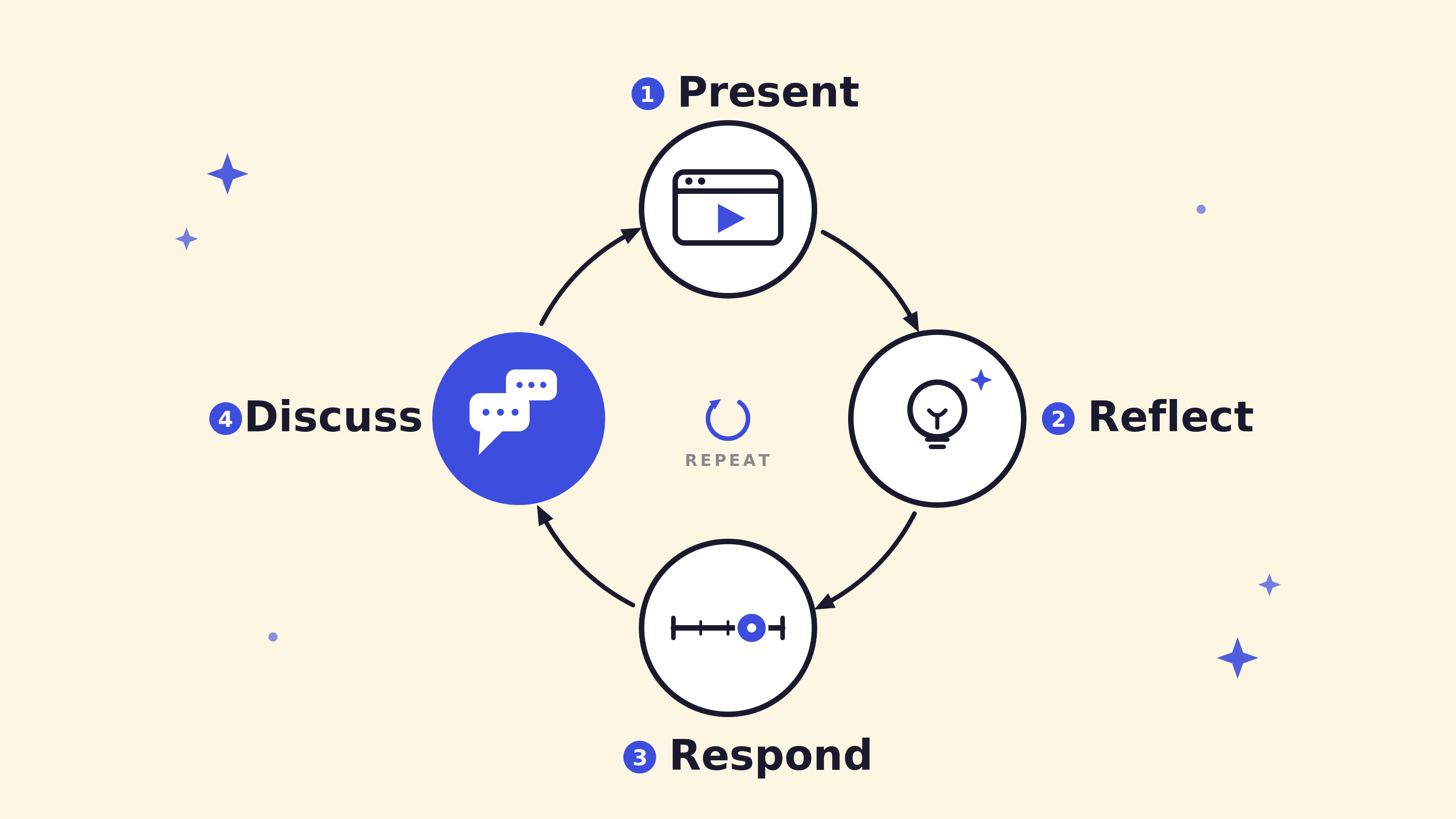
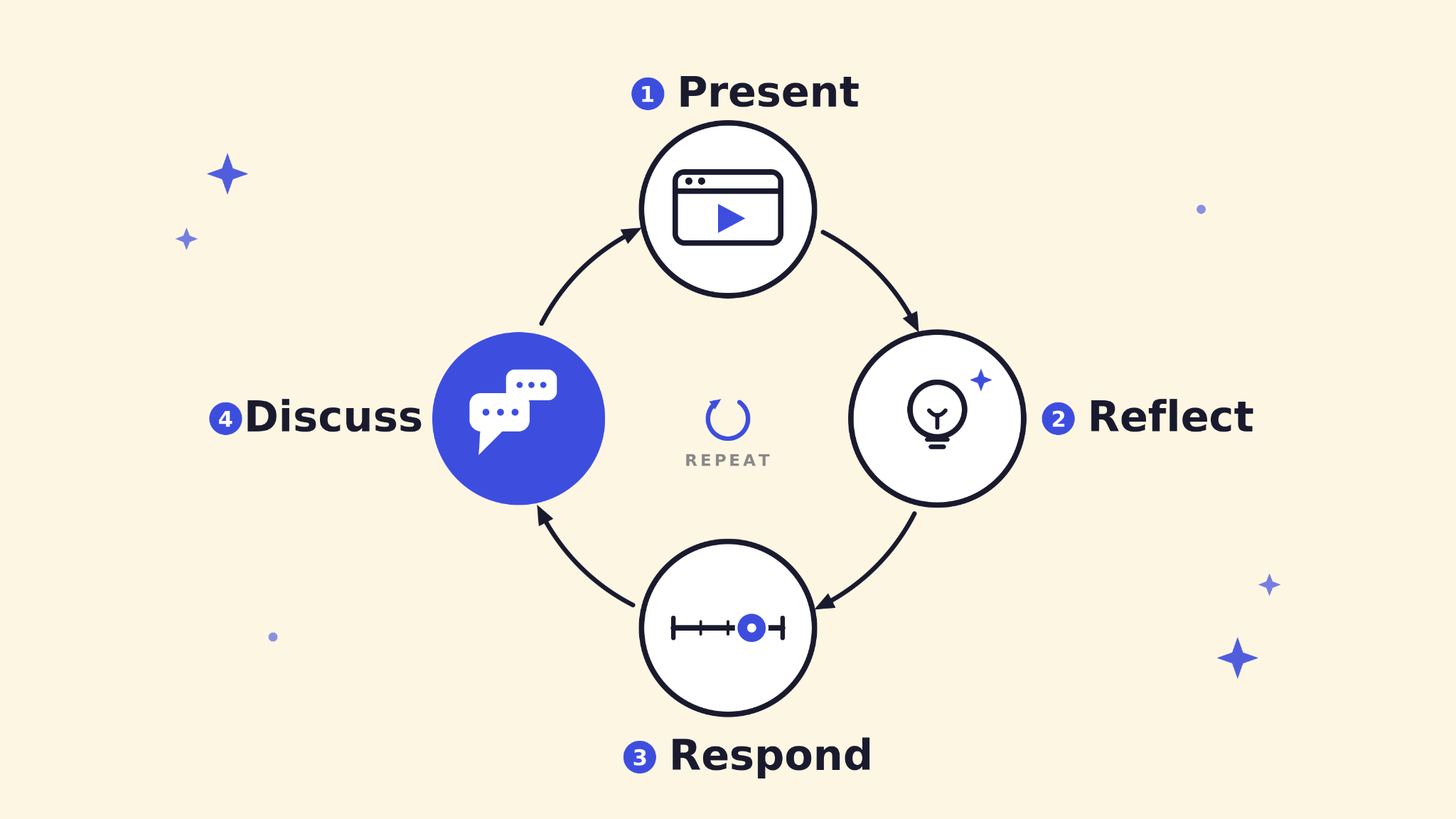
If you take one practical thing from this post, make it this rhythm: present, reflect, respond, discuss. Introduce an idea briefly. Let every individual reflect on it. Invite a response. Then bring the group together to talk about what they're seeing. It's a small, repeatable pattern—and almost any section of any session can be rebuilt around it.
This rhythm is the backbone of how we design at Makeshapes, where experiences guide small groups through this rhythm and toward an outcome—no expert facilitator required. But you don't need a platform to apply the principle. You just need to make the decision that the conversation is the point of the learning experience. Choose a platform that helps you reach it.
At Makeshapes, we've built our platform around a simple belief: conversation is where learning happens. Our experiences guide small groups through a natural rhythm—present, reflect, respond, discuss—so every voice gets a way in and dialogue does the heavy lifting, all without needing a skilled facilitator in the room. That means anyone, from trainers to team leaders, can run sessions that build psychological safety and shared understanding, regardless of participant location, language, or ability.
Facilitate transformative group learning at scale with Makeshapes—the kind built on genuine conversation, not passive content. Contact us today to learn more about how Makeshapes can help you reimagine group learning and create truly impactful experiences for your organisation.

challenge

solution
Designing for discussion: Why dialogue is the destination
Think back to the best learning experience you've ever had at work. Chances are, it wasn't the slides you remember. It was a conversation—a moment when a colleague said something that reframed a problem, when you heard how someone else handled a situation you'd been wrestling with, or when you said an idea out loud for the first time and discovered what you actually thought.
We don't gather just to watch a screen. Yet so much group learning is designed as if we do: a room (or a video call) full of people, an expert presenting, and discussion squeezed into whatever minutes remain at the end (also the first thing cut when the agenda runs long).
At Makeshapes, we'd argue this gets the design of learning experiences exactly backwards. Discussion isn't the bit after the learning. Discussion is the learning. Everything else in a session—the video, the framework, the activity—exists to feed it. When we treat dialogue as the destination rather than the epilogue, our design choices change dramatically.
Why dialogue does the heavy lifting
The case for conversation isn't just intuitive—it's grounded in learning science.
Talking is processing. Articulating an idea in your own words forces you to retrieve it, organise it, and connect it to what you already know—a far more active form of encoding than listening. Research on the "protégé effect" shows that people learn material more deeply when they expect to explain it to others, and deeper still when they actually do.
- Other people are the context. Most workplace learning fails not at knowing but at doing, sometimes called the knowing–doing gap. Hearing how a peer has applied (or struggled to apply) an idea in your shared context does something no piece of content can: it makes the idea real, local, and actionable.
- Social learning is sticky. Neuroscience suggests that learning with others activates regions of the brain associated with attention, social connection, and reward. We encode more deeply when there are humans in the loop—which is partly why a conversation from years ago can stay with you while last month's e-learning module has evaporated.
- Commitment happens out loud. Saying "here's what I'm going to do differently" to a group of peers creates a social accountability that no quiz score can match.
The hard part: Discussion has to be earned
If conversation is so powerful, why is so much of it flat? Because a good discussion doesn't happen on command. "Any questions?" and "Turn to the person next to you…" are invitations most people quietly decline. Discussion has to be designed for—and that design starts well before anyone opens their mouth.
Here are the principles we keep coming back to:
- Cut content ruthlessly. This is the uncomfortable first step. Every minute of presenting is a minute not spent processing, practising, or sharing. Ask this of each piece of content: Does the conversation need this to happen? If not, it's competing with the conversation—cut it, shorten it, or send it as pre-work. A useful test: If your session is 60 minutes, does at least half of it involve people talking to each other? The presenter’s restraint is a feature, not a compromise.
- Connection before content. People won't say anything interesting to people they don't feel safe with. Open every session with a low-stakes way for participants to connect as humans—ideally one that links to the purpose of the session and invites (but never forces) a little vulnerability. That early deposit of safety is what makes honest dialogue possible 40 minutes later. (We've written more about designing for psychological safety here.)
- Allow everyone to respond. The single biggest threat to a group conversation is the loudest voice drowning out the rest. The fix is structural: Before opening the floor, have every participant reflect and record their own response individually—a quick poll, a post-it, a position on a scale, a word. This does three things at once. It guarantees share of voice, because everyone has contributed before the discussion starts. It gives quieter and more junior people a stake in the conversation. And it commits each person to their own view before they hear the room's.
- Make the group visible to itself. Individual responses, shown back to the group, are a discussion engine. A spread of opinion on a scale, a word cloud of assumptions, a wall of ideas—these elements surface the alignment, difference, and patterns that give a group something genuinely worth talking about. "Why are we split down the middle on this?" is a far better prompt than "What did everyone think?"
- Ask questions that have no safe answer. Recall questions ("What were the three steps?") produce recitals. Experience and judgement questions ("Where have you seen this go wrong?", "Which of these would be hardest on your team and why?") produce conversations. The best discussion prompts are ones the presenter genuinely couldn't answer alone.
- End in commitment, not summary. Don't let the energy of a good discussion dissipate into "Thanks, great chat!" Close by having each person reflect privately and name one thing they'll do differently—then invite people to share if they are comfortable. The discussion built the insight; the commitment carries it out of the room.
A simple rhythm to design by
If you take one practical thing from this post, make it this rhythm: present, reflect, respond, discuss. Introduce an idea briefly. Let every individual reflect on it. Invite a response. Then bring the group together to talk about what they're seeing. It's a small, repeatable pattern—and almost any section of any session can be rebuilt around it.
This rhythm is the backbone of how we design at Makeshapes, where experiences guide small groups through this rhythm and toward an outcome—no expert facilitator required. But you don't need a platform to apply the principle. You just need to make the decision that the conversation is the point of the learning experience. Choose a platform that helps you reach it.
At Makeshapes, we've built our platform around a simple belief: conversation is where learning happens. Our experiences guide small groups through a natural rhythm—present, reflect, respond, discuss—so every voice gets a way in and dialogue does the heavy lifting, all without needing a skilled facilitator in the room. That means anyone, from trainers to team leaders, can run sessions that build psychological safety and shared understanding, regardless of participant location, language, or ability.
Facilitate transformative group learning at scale with Makeshapes—the kind built on genuine conversation, not passive content. Contact us today to learn more about how Makeshapes can help you reimagine group learning and create truly impactful experiences for your organisation.
challenge
solution
Designing for discussion: Why dialogue is the destination
Think back to the best learning experience you've ever had at work. Chances are, it wasn't the slides you remember. It was a conversation—a moment when a colleague said something that reframed a problem, when you heard how someone else handled a situation you'd been wrestling with, or when you said an idea out loud for the first time and discovered what you actually thought.
We don't gather just to watch a screen. Yet so much group learning is designed as if we do: a room (or a video call) full of people, an expert presenting, and discussion squeezed into whatever minutes remain at the end (also the first thing cut when the agenda runs long).
At Makeshapes, we'd argue this gets the design of learning experiences exactly backwards. Discussion isn't the bit after the learning. Discussion is the learning. Everything else in a session—the video, the framework, the activity—exists to feed it. When we treat dialogue as the destination rather than the epilogue, our design choices change dramatically.
Why dialogue does the heavy lifting
The case for conversation isn't just intuitive—it's grounded in learning science.
Talking is processing. Articulating an idea in your own words forces you to retrieve it, organise it, and connect it to what you already know—a far more active form of encoding than listening. Research on the "protégé effect" shows that people learn material more deeply when they expect to explain it to others, and deeper still when they actually do.
- Other people are the context. Most workplace learning fails not at knowing but at doing, sometimes called the knowing–doing gap. Hearing how a peer has applied (or struggled to apply) an idea in your shared context does something no piece of content can: it makes the idea real, local, and actionable.
- Social learning is sticky. Neuroscience suggests that learning with others activates regions of the brain associated with attention, social connection, and reward. We encode more deeply when there are humans in the loop—which is partly why a conversation from years ago can stay with you while last month's e-learning module has evaporated.
- Commitment happens out loud. Saying "here's what I'm going to do differently" to a group of peers creates a social accountability that no quiz score can match.
The hard part: Discussion has to be earned
If conversation is so powerful, why is so much of it flat? Because a good discussion doesn't happen on command. "Any questions?" and "Turn to the person next to you…" are invitations most people quietly decline. Discussion has to be designed for—and that design starts well before anyone opens their mouth.
Here are the principles we keep coming back to:
- Cut content ruthlessly. This is the uncomfortable first step. Every minute of presenting is a minute not spent processing, practising, or sharing. Ask this of each piece of content: Does the conversation need this to happen? If not, it's competing with the conversation—cut it, shorten it, or send it as pre-work. A useful test: If your session is 60 minutes, does at least half of it involve people talking to each other? The presenter’s restraint is a feature, not a compromise.
- Connection before content. People won't say anything interesting to people they don't feel safe with. Open every session with a low-stakes way for participants to connect as humans—ideally one that links to the purpose of the session and invites (but never forces) a little vulnerability. That early deposit of safety is what makes honest dialogue possible 40 minutes later. (We've written more about designing for psychological safety here.)
- Allow everyone to respond. The single biggest threat to a group conversation is the loudest voice drowning out the rest. The fix is structural: Before opening the floor, have every participant reflect and record their own response individually—a quick poll, a post-it, a position on a scale, a word. This does three things at once. It guarantees share of voice, because everyone has contributed before the discussion starts. It gives quieter and more junior people a stake in the conversation. And it commits each person to their own view before they hear the room's.
- Make the group visible to itself. Individual responses, shown back to the group, are a discussion engine. A spread of opinion on a scale, a word cloud of assumptions, a wall of ideas—these elements surface the alignment, difference, and patterns that give a group something genuinely worth talking about. "Why are we split down the middle on this?" is a far better prompt than "What did everyone think?"
- Ask questions that have no safe answer. Recall questions ("What were the three steps?") produce recitals. Experience and judgement questions ("Where have you seen this go wrong?", "Which of these would be hardest on your team and why?") produce conversations. The best discussion prompts are ones the presenter genuinely couldn't answer alone.
- End in commitment, not summary. Don't let the energy of a good discussion dissipate into "Thanks, great chat!" Close by having each person reflect privately and name one thing they'll do differently—then invite people to share if they are comfortable. The discussion built the insight; the commitment carries it out of the room.
A simple rhythm to design by
If you take one practical thing from this post, make it this rhythm: present, reflect, respond, discuss. Introduce an idea briefly. Let every individual reflect on it. Invite a response. Then bring the group together to talk about what they're seeing. It's a small, repeatable pattern—and almost any section of any session can be rebuilt around it.
This rhythm is the backbone of how we design at Makeshapes, where experiences guide small groups through this rhythm and toward an outcome—no expert facilitator required. But you don't need a platform to apply the principle. You just need to make the decision that the conversation is the point of the learning experience. Choose a platform that helps you reach it.
At Makeshapes, we've built our platform around a simple belief: conversation is where learning happens. Our experiences guide small groups through a natural rhythm—present, reflect, respond, discuss—so every voice gets a way in and dialogue does the heavy lifting, all without needing a skilled facilitator in the room. That means anyone, from trainers to team leaders, can run sessions that build psychological safety and shared understanding, regardless of participant location, language, or ability.
Facilitate transformative group learning at scale with Makeshapes—the kind built on genuine conversation, not passive content. Contact us today to learn more about how Makeshapes can help you reimagine group learning and create truly impactful experiences for your organisation.
challenge
